


Fugitive of Time
The Idea of an Entire Life, by Billy-Ray Belcourt, is at once a love letter to poetry and queer Indigeneity—and a sustained act of refusal.
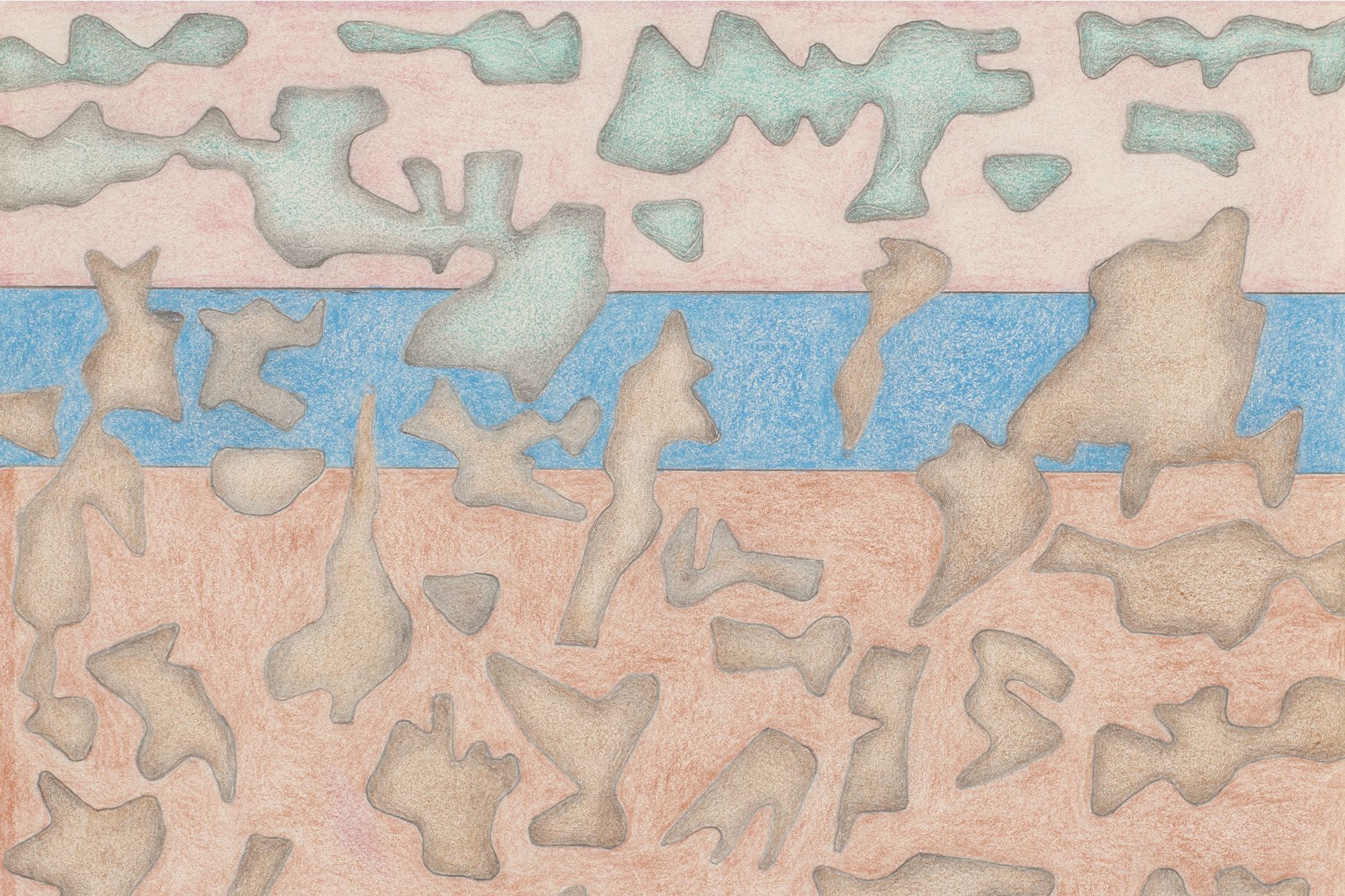
George Morrison, Red Rock Variation (1986). Collection of Tweed Museum of Art, UMD. Alice Tweed Tuohy Foundation Purchase Fund. © George Morrison Estate. Courtesy the estate and Bockley Gallery.
As a Lakota and Dakota child of the 1990s, raised between the California cities of Oakland and Fort Bragg, my public school curricula covered poetry, but never by Native authors. It wasn’t until I discovered Tommy Pico and Layli Long Soldier in college that I finally saw my culture reflected in contemporary verse. These poets refuse the solipsism of white American titans like Ralph Waldo Emerson and Walt Whitman—writers who, at their best, treated the land as anonymous, and, at their worst, cast Native peoples as stereotypes or inevitable victims of progress. Billy-Ray Belcourt’s The Idea of an Entire Life (Beacon Press, 2025) continues that refusal through sonnets, fieldnotes, and fragmented lyrics that test the limits of desire and embodiment, history and futurity, Indigeneity and settler colonialism.
Belcourt is an Indigiqueer poet hailing from the Driftpile Cree Nation in Northern Alberta. A Rhodes scholar, he also became the youngest recipient of the Griffin Poetry Prize for his debut collection, This Wound is a World (2017). That book, like many of the five that followed it, defies categorization, blending memoir, manifesto, and lyricism to explore themes of queer Indigeneity, love, trauma, and decolonial futures. At once a love letter to poetry and queer Indigeneity, Belcourt’s love-as-liberation dialectic evolves throughout his collections into a fixation on how death permeates Indigenous life—from disproportionate violence affecting Indigenous youth to the death of his Kokum (grandmother). His voice reaches a world-weary, even moribund register in his new collection.
In “Endnotes,” Belcourt writes:
*
In my country, death is a door that swings open.
Onto all the trees in the neighborhood, I wrote:
UP CLOSE A NATIVE IS A DEMONSTRABLE
IMPOSSIBILITY.
*
When I told my kokum I was homesick,
she said: If heaven is a place, my dear,
I’m afraid it’s already underwater.
*
Unsurprisingly, the past makes me
painfully available to the world.
•
In this tree-lined neighborhood, Native absence is assumed, yet there Belcourt stands, quietly exposing the strangeness of being present in a place built over his ancestors’ erasure. Kokum appears throughout the book as both witness and companion, her invocation of water running like a current between her afterlife and our present. Belcourt confronts what many turn away from: the ghosts of Indigeneity and the slow collapse of the socio-ecological world around us. He brings Kokum forward as a figure of grief and endurance, linking her to Roland Barthes’s idea of mourning as a “painful availability” after the death of his mother in 1977:
Mourning: not a crushing oppression, a jamming (which / would suppose a “refill”), but a painful availability: I am / vigilant, expectant, awaiting the onset of a “sense of life.”
Belcourt telegraphs a similar vigilance—a pensive expectation of recurring pain—to his readers.
While the land bears its own historical pangs, Belcourt identifies the body as another battleground soaked in blood. “When I said the instabilities of the self reveal the publicness of our emotions // I meant that loneliness is a kind of season; it falls on us like rain,” he writes in “An Entire Life.” Feeling descends onto bone, turning the body into a volatile weather system. Where others, like Tomy Pico—whose rapid-fire lines recall Frank O’Hara’s urban rush—track emotion through digital life, Belcourt fixes his gaze on the body itself: messy and mortal, making and marked by rain.
Maybe the body
really is a necessary fiction. Once, in a hospital,
my gallbladder malfunctioning, I saw the arc
of my entire life and there was an equal amount
of joy and heartache and somehow I still loved
the idea of An Entire Life.
Pico translates embodiment into millennial shorthand, compressing the nuances of urban queer Indigenous life into a text-and-Grindr-message hybrid form, while Belcourt turns dystopian—a Cassandra who transforms physical fallibility into both reliquary and warning, insisting that emotion must pass through our transient forms before returning to the stars.
In “The Past Tense,” Belcourt writes:
The mind is an absent ruler.
It is a shape I try to fill in.
Most days I am as hungry
as a shoreline.
The lake is my ancestor,
even if it will outlast me.
I am serious when it comes
to desire, if only because
a man is a difficult thing
to dwell inside of.
Recognizing that contemporary Native identities are shaped—and often trapped—by history, Belcourt layers North American colonial references throughout his work, defying temporal and spatial boundaries, while mirroring a physical world inscribed with monuments and street names honoring genocidal figures—from Queen Elizabeth II and Edward Cornwallis to Columbus and Father Junípero Serra.
“The Past Tense” creates a portrait of Native experience and landscape that feels both particular and universal—at least for those communing with emotion and homeland. The poem’s sense of scale verges on the abstract. He continues:
The present consists
of that which precedes it.
It’s simple, I know, but
this simplicity pains me.
Inside the past
are my family’s memories.
Sometimes, without
warning, all the music
in me dies. Poof
I am too young to have
to remember so much.
In “The Past Tense,” and throughout the collection, Belcourt returns to land and history, making monuments of them and casting them as primary characters in his life. “I lived / with the vastness and loneliness of a continent,” he writes in “Utopia”—a line that resonates both with the isolation of his remote Canadian homeland and the burden of historical loss experienced by many Native communities. This distance threads his work into a long tradition of Native art, from Métis floral quillwork and Navajo woven tableaux to George Morrison’s landscape abstractions. What some might mistake for nostalgia emerges in Belcourt as something else entirely: a contemporary ache that settles into body and memory with stubborn, lucid force.
Morrison, an Ojibwe artist from Minnesota, also used landscape to map the ties between land and city, merging Lake Superior’s horizons with Manhattan’s steel arteries to reveal how geography carries its own layered histories. For Belcourt, the present fuses inherited memory, complex family relationships, and sexual escapades; for Morrison, it materializes as horizon lines, continuous yet fractured by Western contact. In “Childhood Triptych,” Belcourt recalls a forest seen from his childhood kitchen window, “a landscape painting that got repainted until all of it became / a blur of green.” The image merges memory, land, and loss into a single field of color—an abstraction not unlike Morrison’s horizon—rendering childhood itself as a landscape someone else “was supposed to know by heart.”
Belcourt refuses the anthropological categories into which Native people were once stuffed to make them visible to the metropole. In “The Closet” he writes, “When I was young I was already old,” connecting lifelong trauma along racial and sexual lines. The compounding pressures of history and desire, he suggests, age the self before its time. “The closet is such an ugly / metaphor; I wasn’t invisible,” he adds, recasting the space not as a void but as a charged third zone: space rather than a void. “What strange luck, / in the end, to be most yourself in the dark—all that light churning inside you.” Belcourt refuses to be spoken for, carving a place beyond the labels the state imposes. As the scholar Audra Simpson argues, refusal is a form of power—a mode of survival that denies the colonizer the satisfaction of control. Belcourt is no descendant of Duncan Campbell Scott’s “Indian poet,” that colonial invention meant to prove Indigenous people could be civilized through verse, nor is he simply a child of Dionne Brand’s diasporic lyricism. Instead, he moves as a fugitive through his dream-worlds, where lyric becomes a means of escape rather than enclosure. His fugitivity is artful, a way of living beyond the names imposed on him.
In “The Cruising Utopia Sonnets,” he challenges the settler frameworks that define Native life—citizenship and blood quantum and lineage. Rejecting these measures of legibility, he writes: “We are not yet what we touch. / Our historical consciousness is a difficult dream.” In doing so, he becomes a fugitive of time, shaping a self through poetry that escapes the colonial gaze.
As Simpson writes, empire tried to control not just land, but bodies, histories, and ways of being. But Belcourt refuses to be spoken for: “We need fewer anthropologists and more minor poets,” he declares in “Subjugated Knowledge,” celebrating his genre-bending poetry’s power to escape imposed categories. For him, refusal is a way of living outside colonial rules. Love and desire become his most radical acts of visibility. Erotic attention is his tool for seeing and being seen—without surrendering to the state’s dishonorifics of recognition—“1/4 degree of Indian blood” or “Homosexual.”
Belcourt writes of containment through the lens of desire, as in his sonnet “Utopia”: “On Grindr my profile stated: DESIRE IS A PLANET / TRAPPED INSIDE AN EVEN BIGGER PLANET. // The men I met were aroused by the world; / I was aroused by the opposite of the world.” The metaphor operates on impossible scales: desire is already planetary—vast and gravitational—yet trapped within something even larger, perhaps the body or the world itself. Each sphere is complete yet contained, like a nested system of confinement. By conferring planetary scale on desire and embodiment, Belcourt both measures their vastness and grants them physical definition, positioning one inside the other.
The “night inside a single man” in “Utopia” transforms desire from abstract planetary metaphor into a visceral threat. To be contained within another’s vastness—or to contain such vastness oneself—becomes “a kind of violence.” This isn’t a particular scene from Belcourt’s life, but a daily reality of body, solitude, sexuality, and the loneliness of an orientation opposed to reproduction. In “The Queer Utopia Sonnets,” Belcourt asks, “What is a body in the present tense?” He folds queer desire and the ache of abandonment into a wry logic of his own. “What is a mourning but a queer fatherland / we can make claim to? I want to believe / in the possibility of an existing gay lifeworld.”
Belcourt tacitly acknowledges Judith Butler’s critique of gender’s performativity—“gender is a performance with clearly punitive consequences”—yet moves beyond it. “The problem with pleasure,” he writes, “is that / two people can meet in a room / in order to exist less.” Where Butler highlights punishment and the scholar José Esteban Muñoz reframes it as queer worldmaking, Belcourt seeks something more elusive: desire lived beyond ritual, performance, or representation. “Most days I’ve wanted / to be my desires and not merely / the unrelenting density / from which they rush forth.” In doing so, he troubles not gender but sexuality itself as a daily practice, returning to a Native understanding of sex—an act of cosmological continuity rather than iteration.
In “Form,” he admits this sacred unity: “Suppose / love really is a willingness / to experience the same / disappointments, joys.” Emerging from darkness into a shared room, Belcourt enacts another mode of refusal, one that resists state-sanctioned belonging and instead performs a queer love that extends and embellishes bodily life through its tenderness.
Petala Ironcloud is a Lakota/Dakota and Jewish writer and textile artist from California, based in New York City. Their work has appeared in the New York Times, The Business of Fashion, PAPER Magazine, and others.