


An Ode to "Nobody Does It Better"
On Nate Dogg, Black barbershops, and writer’s block.
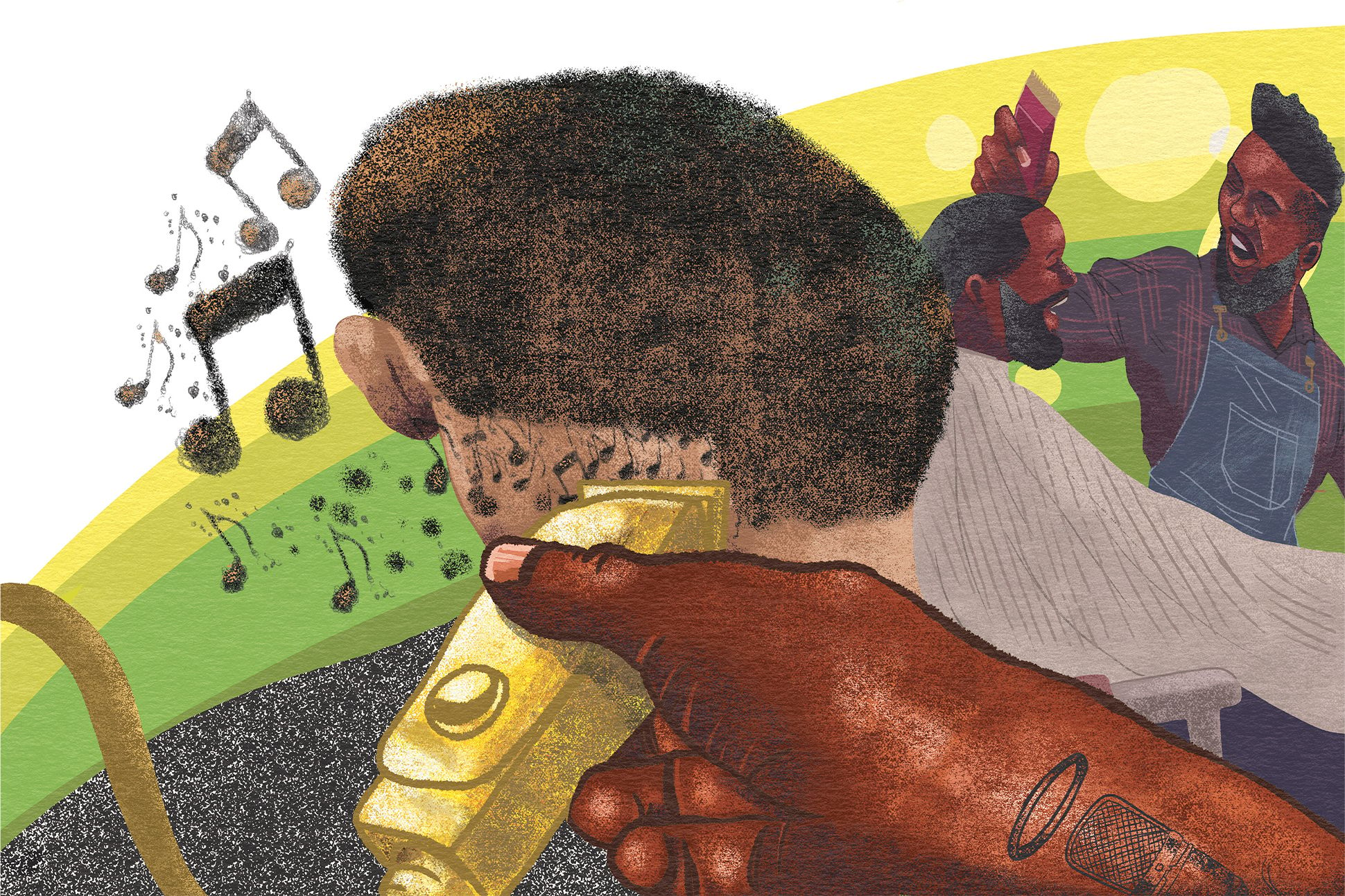
Art by David Cooper.
We didn’t care what we did / Time was nothing to us, we were just kids.
— Nate Dogg
A hater might describe Nate Dogg’s iconic late ‘90s ride-out rap anthem “Nobody Does It Better” as a mellow duet drenched in synth and braggadocio, an uncomplicated tribute to homie love that typifies the West Coast G-funk era. I’ve never liked to side with a hater—it’s bad for my complexion. But here I am 27 summers after the track’s release correcting braggadocio to self-belief and otherwise agreeing, Yes, and—a song about love of home and artistic camaraderie. A song that propels me when I find myself creatively fatigued and rudderless.
“Nobody Does It Better” is part micro-memoir, part persuasive essay, and the mood is Long Beach Noir. Nate Dogg and his day-one collaborator Warren G paint a cinematic portrait of the artist on tour from the Come Up to the Flourish. If the title is the thesis, the song’s pathos shines through from the opening chorus: “They can come closer than close / Original they never will be / We bumpin' from coast to coast / We just tryin' make you see / nobody does it better.” The ethereal beat—a sped-up but no less slick sample of Atlantic Starr’s 1982 R&B single “Let’s Get Closer”—is a testament to Warren G’s virtuosity behind the boards. But it’s the vocal dynamism that makes me want to take up arms against the unnamed haters, all the nonbelievers who called the four-year lull that followed the success of Grammy-nominated hip hop hit “Regulate” an indication of a one-hit duo. In “Nobody Does It Better,” Nate’s deacon-esque baritone embellishes minorly funky rhythm guitars, never once overpowering the delicate keyboard loop. Warren’s delivery is laidback, effortless. The sound of their friendship is real. You can hear it in the comfortable pockets of silence they yield to one another while trading lines: “Strike one, me and Nate Dogg is a match / Strike two, leave 'em standing still in their tracks.” There’s an infectious sense of regard that suspends time.
I felt it the moment I heard the drums drop, age 13, en route to a seedy party store, aptly named The Party Store, to buy Faygo pop and Chick-O-Sticks, darting down a long hill in a pack of other 13-year-old boys, radio in tow, wordless and strangely content. The four of us testing the boundaries of our autonomy at the threshold between middle school and high school, sunset and curfew. Pocketing our thin silver chains and Fossil watches at the intersection of Stamford and MacArthur Boulevard—a visible marker dividing Oakbrook, the multiracial suburb we grew up in, from Sycamore Meadows, a grittier part of Ypsilanti, Michigan, known as “The Green” for its drug economy.
My friend B. stopped pedaling to still the swinging boombox he’d zip-tied to the handlebars of his Mongoose. He steadied it with one lanky knee and a sagging jean shorts buffer, probably FUBU. The Thorton brothers—aloof, fly seniors—pulled up next to us at a stop sign in the old-school Cutlass they shared. When the synthesizers faded out, B. reached to eject the tape and cue the instrumental, and either the car backfired or one of the brothers revved the engine. Either way, I jumped like a shot had rung out.
Maybe they didn’t see it, I don’t know. I was expecting a full-throated laugh, at least a snicker. Instead, they nodded at us in unison as the song kicked on and Nate’s voice blasted simultaneously from B.’s boombox and from their stereo, affirming our refined musical palates. I won’t speak for my boys, but it was the first time in my teen life I had been mistaken for cool. And I carried that recognition with me—through jazz and marching band in my high school years, through poetry slams on a squat stage at a hole-in-the-wall Kalamazoo bar my senior year of college, where I over-imbibed cheap raspberry ale in clear mouthwash cups with a revolving door of kindred characters who loved words, battle rap, and jam bands (yeah, I know). If not cool, then a budding sense that the right metaphor, the right bounce or crescendo, could propel me in style or disguise like a good set of struts over a pitch-dark pothole or any rocky unknown up ahead. That putting myself in close proximity to people who deeply feel or make art—who’d prefer to see the world electrified or smoothed out—was a fairly reliable way to stoke my general optimism.
This has been at least half the story of my life. The story of every OutKast, Kendrick Lamar, and Curtis Mayfield reference that finds its way into my poetry. The story of my lucky day job now teaching creative writing at a state university in Memphis, a city that was once home to Al Green, Isaac Hayes, and Elvis Presley at the same damn time. A soulful, salt of the earth city with no fewer than a dozen playhouses and centers for the performing arts. And I won’t sit here with a straight face and say “Nobody Does It Better” is the reason I became a writer-prof, but I won’t say it didn’t spark a personal renaissance either. I need Nate Dogg and Warren G to have all of their flowers.
***
The next time the track centered me I was 26 and 850 miles from home at the Fine Arts Work Center in Provincetown, where I’d been living with 19 other makers for five months, struggling to draft the final poems for what became my debut collection, Maybe the Saddest Thing. The book’s title is a bit of a playful wink, a nod to the speaker’s compulsion to interrogate everything: easy joy and love, the long-term effects of casual intolerance, the cultural significance of Flavor Flav. Technically, I was living the dream: revising and rewriting the book, reading—or trying to read or write—some nights from dusk till noon, with a long break for breakfast, a walk with another fellow, and one or three reruns of Charmed. But, in hindsight, I can see now that I was also stuck in a paralytic funk that still emerges when I’m several years into a project and close enough to completion to see the finish line is still a hike away.
Imagine you’ve laid out 30 mostly published poems on your living room floor, labeled and flagged the themes with multicolored sticky notes, and arranged them purposefully. You’ve systematically eliminated the weak spots in your manuscript (debatable). You’ve made a list of ideas, techniques, and forms to fill those gaps, to make your poems come alive. You start and you start but can’t gather enough inertia to pen more than a few stifled thoughts. You stare at your pile of work on the floor and begin to think of it as litter. You think back to your childhood notebooks, stacks and stacks of them spilling out of your closet and drawers. You think about the last umpteen years of your life dreaming of a vessel for your words with your name on the spine, then Google the cost of law school.
I found myself monologuing at my desk late at night: I mean, who’s out here checking for poetry anyway? And couldn’t I have read a little closer that first year of grad school? Written a little longer, more methodically? I spent that first month in Provincetown licking my wounds after getting dumped via email. I stole a week for Christmas with my family back in Michigan, then another in January to be a groomsman at a wedding in Punta Cana that was beautiful and good for my heart. I spent another five days away from my desk interviewing for a college teaching job as part of an “opportunity hire” recruitment program that was equally nourishing and devastating to my ego.
In an effort to enrich the campus community and attract potential faculty of color to a small city in the Midwest, the university invited several guests for a string of presentations, networking events, and a tour of the Clabber Girl baking powder factory. Like a cross between a Verzuz battle and a McSweeney’s article, the English department conducted overlapping interviews with me and the other finalist, a writer I’d bumped into a couple of summers prior at an annual retreat for Black poets. When I say the interviews were overlapping, I mean I nodded at the brother as he exited and I entered. We presented our research not just back-to-back but in front of one another.
The other candidate was soft-spoken, affable. He buttoned and unbuttoned his navy blazer as he announced the title of his first piece. He drew a half-breath, then sputtered the first line. When he held a finger in the air, I pretended not to notice. But I watched as he turned his back on the committee and me. Saw him clear his throat in a practiced recovery. His lapse in motion, broken focus, only momentary. And partially, maybe, my fault?
This is stupid, I thought. I shook my head at the entire enterprise: The drab conference room and coffee-stained club sofas. The assembly line interview gauntlet. A literal lumping together of our voices, of our writing, our academic interests, our vastly different career and life experiences.
If this is academia, I thought, maybe I don’t actually want this life. I was invited to follow up with questions about my fellow Black poet’s presentation. Instead, I thanked him for his work. I had questions for the committee. I kept them to myself.
If I was unimpressed with myself before that interview, I really couldn’t conjure up a “writing feeling” after the search was canceled. I was shook. My confidence was low. One morning I woke up in my drafty cottage in Provincetown to a patchy beard and a knotted mini-fro. I lifted my toothbrush in the bathroom mirror and stopped short when I saw my reflection: a swaggerless, slumped stranger. Twenty-six with old-man nose hairs.
Call it vanity if you please, but a good haircut has always soothed me. Historically, the barbershop has been my most stable third space. A curative source of kinship and relatability, even when I’m new to a town or moving through it anonymously. Sometimes, when I’m lost and feeling less-than, being taken care of—being shown care by a gentle hand—is the only thing that returns me to myself.
I walked 10 minutes to the closest place in town. Inside, I found an old, hunched white man reading the paper in a leather styling chair. Apparently, I was his first customer of the day. I asked if he could cut Black hair and he replied: Yes, but not for some time. I laughed, thanked him for his candor, and backed out slowly, the tiny brass bell over the door ringing Awkward! for me and me alone.
The next day, I discovered an internet repository of Black-owned salons that led me two and a half hours down the road to Boston’s Hyde Park neighborhood. Yes, that’s right, for a haircut. I circled the block two times because the place looked nothing like the photos online. Brown builder’s paper covered most of the storefront window, but the sign on the glass door said OPEN and the lights were on.
Picture, if you will, a small space filled with giant, plastic storage tubs stacked three deep, all around, leaving just enough room for two barber chairs, one dented card chair (occupied by a locked toolbox), and a path from the entryway to another door frame marked EMPLOYEES ONLY. The whole setup felt like a front for some kind of questionable distribution operation, or the least-clandestine secret service outpost in America.
I stood around bundled in the center of the silent room for longer than I should have, saying Hello? every few minutes. Finally, I elected to wave at a security camera mounted above the exit. The barber, looking harassed, entered with a nod. He wore a comically large earpiece that he grunted into once or twice until his chore was finished. I won’t hold you—the cut was mid, and I was salty, which was both unsaid and acknowledged when I handed him $20 for a $15 cut and asked for a dollar back.
You’re probably thinking there had to be Black people in Provincetown I could have asked for a recommendation. And, yes, there was a no-nonsense Jamaican bartender at the Governor Bradford that I was friendly enough with. One night, I pointed earnestly at his gleaming head and asked where he went to get it shaved. He squinted, puffed out his broad chest and said: The bathroom mirror. I tried the internet again a couple weeks later and found a shop about an hour along the Mid-Cape Highway.
***
It was March 16, 2011. The day before, Nate Dogg had succumbed to multiple strokes, taken from us too soon at age 41. I got the news via satellite radio as I was pulling into a parking space on the main drag in Hyannis. The barbershop announced itself before I located the door, a soundscape of unkempt laughter, warm bass, and intermittent Mmm mmm mmms that Black folks who spent summers at their grandparents’ house understand to mean: That’s a damn shame, or Damn, that’s good! An affirmation and Amen for the King of Hooks on the occasion of what felt like an impromptu wake deejayed by Pandora.
I grabbed one of the only open seats below a corner-loaded speaker that gently rattled the walls, kneading little pulses through the vinyl chair and into my spine. My shoulders relaxed. The barber in the first chair said What’s up, pointed at another wall of guys lining the large, one-room shop, and told me it might be a while. I said I’ve got time. Still do.
The brother next to me was sporting military posture and salt-and-pepper hair. He said he couldn’t pick Nate Dogg out of a lineup, but that he’d recognize the “fake gospel voice” anywhere. Nate spent his youth singing at a Baptist church in Clarksdale, Mississippi, where his father was a pastor and his mother led the choir, making Old Skool a Bonafide hater. “21 Questions,” 50 Cent’s 2003 single featuring Nate, dropped and the barber at the far end of the shop said, I used to wear this joint out. I know I missed a lot of calc, but that man [50 Cent] asked 18 questions. Now, if Nate asks two on the hook, and two on the outro, is that not 22 questions? Somebody check my math.
The algorithm arrived on Dr. Dre and Snoop’s “The Next Episode”—one of the many cult classics Nate collaborated on between ‘92 and ‘04—and someone wisely grabbed the aux cord to shield a pair of young ears from the emphatic “motherfuckers” that round out the intro. The volume slid back up as the song petered out. There was a knowing two-second pause . . . then the room belted Nate’s playful coda: Smoke weed every day! A mother yanked her kid by the wrist and stormed out anyway.
We went on like this for a good, long while. A shop full of friends and strangers singing and rapping along to Nate’s catalog in time with the radio, sharing varied but oddly similar testimonies in which something pedestrian Nate sang ambered a formative memory with his inimitable bass: The ex-D3 running back who chanted ‘Til the roof comes off, ‘til the lights go out / ‘til my legs give out, can’t shut my mouth before each game. The suited and booted businessman who understood I got game ‘cause the game was given to me as a nudge to ask his uncle for advice about approaching an older woman, now his wife.
Toilet paper and a flimsy cape crinkled around my neck. The barber hoisted my body into an overstuffed black pleather chair. I told him what I wanted and he nodded, clicking on the clippers. A few minutes into the cut, Nate opened the track: Nobodyyyy. That first synthesizer note fired up and reverberated like a futuristic sound effect preceding an opening title sequence for a blockbuster action flick. The electric guitars did their wha wha thing, and the barber started to feel it, I could tell. My hair careened to the industrial linoleum floor in a scattering of ink-dark coils.
For those uninitiated in the ways of Black barbery, a good lineup is like a starched crease ironed into a pair of dress slacks before you step out into the world. Once the hair has been picked or brushed, leveled or faded out, the barber goes to work on the lineup. Starting at the temples, the hairline is trimmed at a right angle toward the top of the skull and arced evenly above the forehead. Then the barber traces a crescent behind each ear and waterfalls the line parallel with the floor before edging a horizon across the back of your neck. I really love it. The ginger process and electric jolt of calm, transferred through the trimmers, are my version of a boutique facial treatment. A reasonably priced get-right I have pursued twice a month since 16, my brief stint in Ptown notwithstanding.
I too missed my share of math, but I felt confident the geometry being performed on my hairline was going to check out in the mirror. The barber dipped to his right, twisting the trimmers, contorting his wrist with an air of flashiness. He was enjoying his craft, taking an unorthodox route to get to the desired destination. Trusting in the process, working by feel and skill until symmetry was naturally achieved. I drove back to the Work Center in silence with the crispiest of lineups determined to follow his lead.
For the next two months, I let myself off the hook. I spent less time isolated, staring at the wall, beating myself up about not writing, and more time off the page and outside of my cottage. I struck up chats with fishermen at the Portuguese bakery on Commercial Street. I joined a whale-watching tour and took hikes in Beech Forest, where I learned to identify warblers and tanagers for the hell of it. I needed to not think about poetry. Instead, I began to wonder if, by constantly observing the world with a notebook in hand—always through an academic or artistic lens—I’d forgotten how to be in it authentically. This question allowed me to understand my manuscript in a new way. It became the undercurrent that legislated the collection’s sequencing, its “so what,” and by the end of July, its completion.
***
Times are different now but you still get stuck.
I’ve authored two more poetry collections since, with longer fallow periods between books, again and again stalling out near the end of the drafting process. Each time I’m buoyed by a self-imposed distance from the page, and by reminding myself not to let my ambition—writerly or professional—squelch the living. I’m talking about checking on my family and folk more often. But also spending whole days in a garden bed digging through mulch and topsoil, rooting out the bindweed strangling our azalea bushes before they can bloom. Allowing my art to arrive by effort and flexibility, both, as opposed to the kind of dogged pursuit that tends to turn back on me in a rabid bout of self-loathing.
In the 13 years following the publication of Maybe the Saddest Thing, I’ve blamed the pandemic, perfectionism, and (twice) a president for my prolonged bouts with ennui. I’ve identified a decade-long dumpster-fire news cycle, and precipitating anxiety, as the source of extended lapses in productivity. But it’s simpler even, less wordy than that. When imposter syndrome sets in, my biggest hater/nonbeliever, my actual “competition,” is me.
I’m afraid of stop signs. Afraid of being crept up on from behind, before I get started good, of being mulled over at the bottom of a steep incline, when everything is rolling smoothly and I’m gathering momentum toward an upswing. I grab hold of a sound concept, find an interesting hook, and before I can drill down into the poem’s true subject, I start searching for a volta. Looking for ways to complicate an argument I haven’t fleshed out. And because sometimes I’m suspicious of my gaze, afraid that my quality of attention isn’t enough, I stall—write 12 titles, four openings, mix and match them into 48 uninspired directions. Like the Flash stiff-arming an encroaching mob with a sidelong shove in one of my old comic books, I’ve been afraid of time itself. Scared to look backwards and find my life is gaining on me while I’m typing circles at dark hours into a harsh fluorescent screen by my lonesome. I’ve been like this since I was a boy, zooming into my teen years. Since I was a 26-year-old poet with writer’s block trying to vault over his apprentice period—a realization I’ve come to, only now, years later, before sunrise this morning.
Once again, I find myself in the bathroom mirror, for the first time noticing the soft, dark caverns deepening in the corners of my eye sockets. I brush my hair and fail to cover a small splotch of scalp where I’m beginning to thin. I try not to predict the future, to imagine myself rocking a Caesar or Nate’s signature Baldy. I mow down my uneven scruff, try to shave a year off my face without looking too closely at my face, and I can see it now, how I’ve been meandering, tracing my relapsing doubt, my unoriginal fears, with a dull scythe to avoid confronting them directly. But of course, I’m thinking of Nate Dogg when I decide to shear them away. Of course, I’m thinking of his resonance today, on my 41st birthday—about the absolute gift of his voice, a golden chariot riding clean on chrome spokes and hydraulics, easing me forward, raising me up through so many seasons.
Marcus Wicker is the author of three books of poetry: Dear Mothership (2026), Silencer (2017), and Maybe the Saddest Thing (2012), selected by D.A. Powell for the National Poetry Series. His honors include a Harvard Radcliffe Institute Fellowship, a National Endowment for the Arts Fellowship, the Poetry Society of America’s Lyric Poetry Award, a Pushcart Prize, and a Ruth Lilly Fellowship, as well…