


Return to the Sacred Grove
An unlikely dissident inspired by the classics, Tomas Venclova remains Lithuania’s greatest poet.
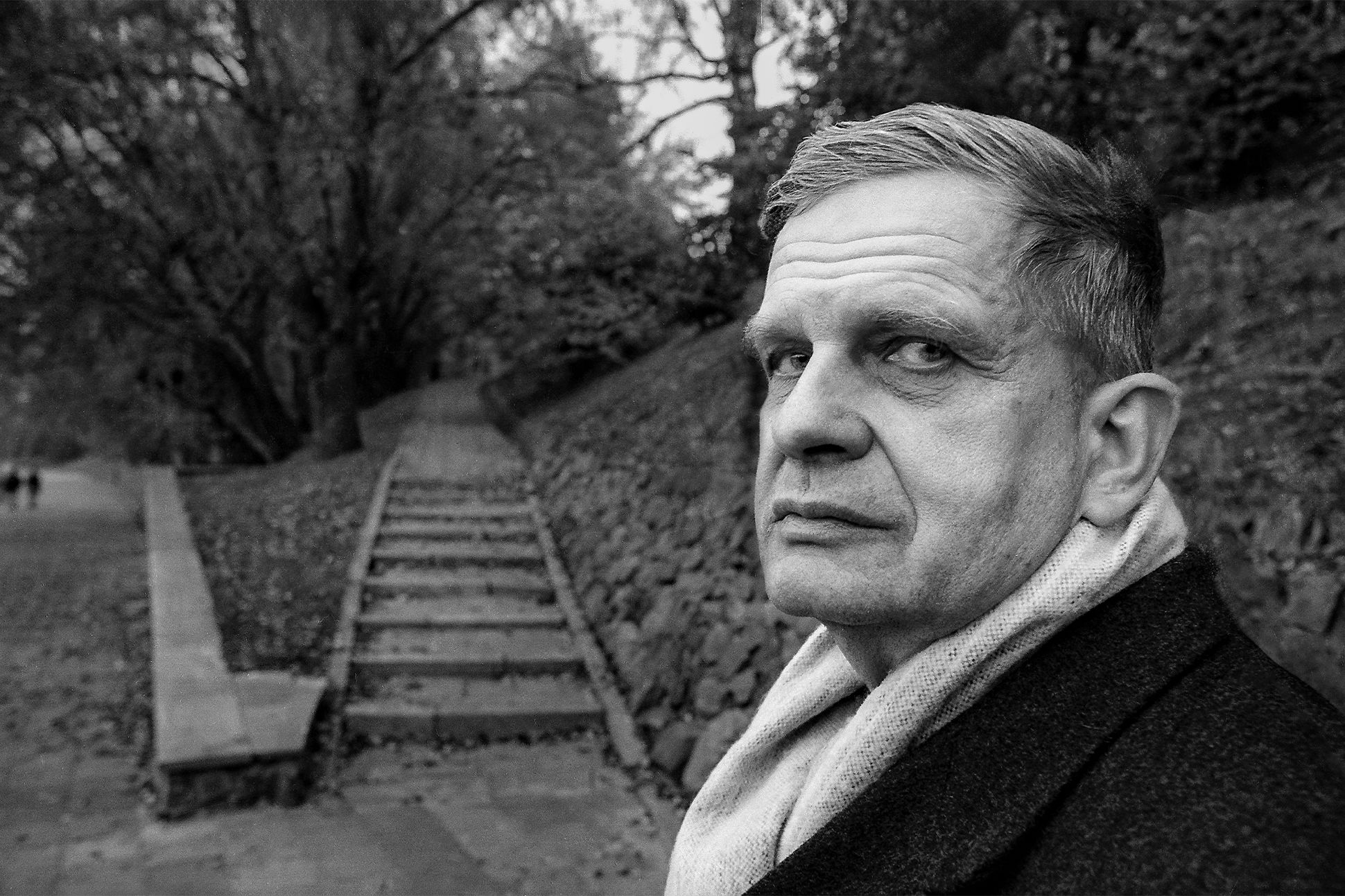
Photo by Algimantas Aleksandravičius.
When Joseph Brodsky left the Soviet Union for good in June 1972, he flew to Austria, where his first order of business was meeting W.H. Auden at his summer house in the small town of Kirchstetten. Brodsky arrived bearing a bottle of trauktinė, a strong, sweet Lithuanian liquor presented to him for the occasion by Tomas Venclova, a Lithuanian poet and translator of both Auden and Brodsky. The gift was more than a way to win over the hard-drinking Auden, who, Brodsky reported, downed his first martini at 7:30 in the morning. It was a symbol of international and interlingual fraternity, and a reminder of the high level of poetic life that persisted behind the Iron Curtain. A few years later, Venclova himself would go into exile after being blacklisted for his dissident activities.
A cerebral poet with a meditative sensibility and meticulous attention to form, Venclova belongs more naturally on the shelf next to his acquaintances Brodsky, Czesław Miłosz, and Anna Akhmatova than among other Lithuanian poets. Rejecting both official Soviet aesthetics and the pastoral folkways typical of Lithuanian verse, he draws much of his inspiration from the classical tradition. This manifests not only in erudite allusions but also in his tendency to linger on architectural and historical details—such as the baroque columns of Vilnius or the Greek traces along Russia’s Black Sea coast. He published one volume in Soviet Lithuania and many more in the United States, where he enjoyed a long academic career at Berkeley, UCLA and, from 1980 to 2012, at Yale University.
At 88, Venclova has not slowed his poetic output, created now in Lithuania, where he returned to live full-time in 2018. His latest English-language collection, The Grove of the Eumenides: New & Selected Poems (Bloodaxe, 2026), features translations by Ellen Hinsey, Diana Senechal, and Rimas Uzgiris. Drawing on work spanning more than a half-century, the selection presents Venclova reflecting on his life and writing what Hinsey calls “poetry of witness and the return of history.”
Venclova was born in September 1937 in Klaipėda, a historically German coastal city administered by the League of Nations from 1918 until a military takeover by the newly independent Republic of Lithuania in 1923. His father, Antanas, a talented and well-known leftwing poet, had been sent to work in a school in Klaipėda and was “expected to take part in the Lithuanianization” of the region, as Venclova later recalled. But in March 1939, before World War II even began, Klaipėda was occupied by the Nazis. Hitler himself arrived by ship and delivered a speech from a balcony of one of the Prussian-style buildings. In the poem “Prehistory,” Venclova locates himself in these crosshairs:
German girls gathered on the other side of the tracks,
saying Süsses Kind over the strollers along their path.
They yearned for the empire’s signs, walked the yellow
sand, and applauded the shadow on the balcony in the old
town
After the Nazis arrived, Venclova’s family retreated to the interwar Lithuanian capital of Kaunas, where he formed his earliest childhood memories, recounted in the poem “It’s not instantly clear why it rises so rich” (sometimes titled “It’s not instantly clear why it comes up so rich”). He remembers Kaunas “as if a strong lens had refined it; / An Art Deco ornament seen through a breach / In the branches.”
In the 1930s, Venclova’s father led a movement and journal of leftwing poets called Trečias Frontas, or “Third-Front,” which sought to capture the avant-garde aesthetics of the 1920s while opposing Lithuania’s interwar authoritarian president. When the Soviets occupied Lithuania in 1940, Antanas was appointed Minister of Education in the new Lithuanian Soviet Socialist Republic and took a seat in the People’s Parliament. A year later, when the Nazis invaded the Soviet Union, Tomas moved with his mother to her father’s nearby home. His grandfather, a professor of classics, would have a marked influence on the young poet, while Antanas spent the war years in Moscow and reporting from the front. “The grim system that surrounded us during my early school and university years was bearable as long as Grandfather was around,” Venclova remembered. “He was a living link to better times, not just prewar Lithuania or prerevolutionary Russia, but the Enlightenment, the Renaissance, and Antiquity.”
When the Red Army pushed out the Nazis in 1944, Antanas returned to Lithuania and moved the family to the restored capital of Vilnius. He composed the lyrics to the Soviet Lithuanian anthem, won the Stalin Prize in 1952 and, two years later, became head of the Lithuanian Writers Union. Whereas Brodsky lived modestly with his parents “in a room and a half” in Leningrad, as he described it in a famous essay, the Venclovas resided on the first floor of a hilltop Art Deco villa, surrounded by a large garden, with a live-in maid. Unusually for the Soviet period, his mother didn’t work, and the family had a car, driver, and summer house. But his father’s enormous library provided a world of references for the younger Venclova, allowing him to look past what he saw as a moribund Soviet present and connect with a broader European artistic tradition. Poems in The Grove of the Eumenides find inspiration in the sculpted portal of a Croatian cathedral, Krakow’s 19th-century green belt park, and Greek tragedy.
One of the poems selected from his most recent collection is titled “Landscape with Polyphemus,” after a painting by Nicolas Poussin held at the Hermitage Museum in Saint Petersburg. Here are the first two stanzas, as rendered by Uzgiris, who gracefully restates Venclova’s original rhymes:
In ruddy mountain depths – deep caves drone in emptiness.
Cold frosts the path. Water trembles in clear autumn’s reign.
Like an attentive blind man, the landscape snares our voices –
With its calloused ears, its knots of nerves, its giant’s brain.
Don’t hide from fate, relish the day and, thick with salt,
The line of spume that marks the sand at low tide.
Wind plucks at trees and ruffles grass, empties the fireside –
Its pit blackens far away, on the heights, like an eye-socket.
And yet the ironic origin of Venclova’s appreciation for art history is that in 1955, as a teenager, he saw an exhibition in Moscow of Dresden’s Old Masters Picture Gallery, a magnificent collection brought home by the Red Army as a trophy of war and symbol of Soviet triumph. “There were enormous crowds milling around the museum,” he remembered, “but Father was permitted, along with Mother and me, to jump the queue as he was a member of the Supreme Soviet. That was my very first encounter with outstanding European painting.”
Given this upbringing, Venclova was an unlikely dissident. But in 1956, while studying at Vilnius University, his worldview was shaped by major events in the Eastern Bloc, from the Polish protests and the Hungarian anti-Soviet uprising to Khrushchev’s denunciation of Stalin. He began to test the waters of protest himself, first in a student newspaper, then by participating in unofficial gatherings and making provocations at the Writers Union. Beginning in 1961, he came under the scrutiny of the KGB due to his involvement with underground publications and study groups. He moved to Moscow, where he had relatively more freedom, and studied under semiotician Yuri Lotman at the University of Tartu in Estonia.
A few years before, in Leningrad, Venclova had a fateful encounter with Anna Akhmatova, the éminence grise of Russian poetry and a declared “enemy of the state,” who nonetheless continued to hold informal salons. Akhmatova, then 74, represented for Venclova “a living link to a different era” of pre-revolutionary Russian culture. He became one of her designated Lithuanian translators and, a few years later in Vilnius, met her protégé Joseph Brodsky, who would become a lifelong friend and supporter. In 1972, Venclova published his first book of poetry, Signs of Speech, in Vilnius. The volume notably lacked the ceremonial introductory poem that signaled fealty to official ideology—“perhaps the first such case in Soviet Lithuania, or possibly in the entire Soviet Union,” he boasted.
Eventually, Venclova’s open and strident criticisms of the government limited his prospects to publish or advance professionally. On May 9, 1975—the provocative date of World War II Victory Day—he tendered a formal request to emigrate. A little less than a year later, Brodsky published an appeal in The New York Review of Books on his behalf, calling him “the best poet living on the territory of that empire of which Lithuania is a small province.” Moving between Vilnius and Moscow, Venclova continued to ramp up his political resistance. In the spring of 1976, the Moscow Helsinki Group formed to monitor the Soviet Union’s compliance with the human rights guarantees agreed upon at the Conference on Security and Cooperation in Europe, held in Finland. Venclova was a founding member of the Lithuanian branch of this movement, which went public in December 1976. This prompted the Soviet authorities to swiftly approve and encourage his emigration a few weeks later.
Although Venclova didn’t meet Auden upon departing, Auden and other English-language formalists, such as Elizabeth Bishop, made an enormous impression on his work. Venclova published a poem titled “The Shield of Achilles,” echoing Auden’s original and dedicated to Brodsky. In The Grove of the Eumenides, his poem “Syllabic Stanzas” mirrors the philosophical ruminations of a traveler found in W.H. Auden’s “In Praise of Limestone.” He observes
a world that has wasted its worth, a world that once fit
between eroding banks and the bus shelter’s borders:
an expanse of ancient guilts and older limestone where
a poverty of neon conjured into a key, rusting in one’s
pocket, into the damp ether’s hum, into suppressed
desire, growing more distant than Saturn, rarely dreamed;
And here is the final, wistful stanza of “Hamden, Connecticut,” which draws on “North Haven,” Bishop’s tribute to Robert Lowell:
Substance does not die, say the theologians.
Or maybe it’s just memory and forgiveness
that remain. We don’t know another universe.
This one should be enough. Let the fog
of photographs console, the four elements,
the hardly visible sign on the table of a glass.
More recently, Venclova has turned this outsider’s gaze to his native Lithuania, with striking effect. In “Beyond St Anne’s and the Bernardines,” the title poem of his 2023 collection, he evokes the ethereal mood and layered history of Vilnius. Some of the lines, as translated by Uzgiris, sound almost like Auden himself:
On this side of three crosses,
the city fits into one’s palm,
and a Doric column answers
cold frost with lucid calm:
I am full of weightless time.
In another stanza, Venclova eerily places contemporary Vilnius in another interwar calm:
Not yet destroyed by wars,
unchanged by passing years,
the stone wall stretched under tin
guarding an unlocked labyrinth:
a realm of rough inscription.
The “return to history” that Hinsey mentions in her introduction is Russia’s 2022 invasion of Ukraine. Venclova departs from his usual detached stance to address the ongoing war in “Azovstal,” a poem about the Siege of Mariupol, whose Azovstal steelworks factory was the last redoubt of Ukrainian fighters in the war’s first months. In the poem, it is the instruments of modern warfare, such as drones, that are detached: “A satellite docked in the heavens / Impassively looks on. Cannon blast a nitrogen cistern: / Ten blocks have been taken.” Comparing the siege to the Battle of Thermopylae between the Persians and Greeks in 480 BCE, he writes, “The path’s cut off: in the end, the Medes will break through.”
But Venclova’s views on the Russia-Ukraine war are more nuanced than “Azovstal” might suggest. In an essay titled “Russians and Lithuanians,” first delivered as a lecture to Lithuanian émigrés in the United States in 1977, he described himself as “an exception” to the typical Lithuanian hatred, in which “a Russian becomes the scapegoat on whom all the misfortunes of the past are heaped.” He cautioned against equating the Soviet Union with Russian imperialism of earlier eras or collapsing Russian politics with its grand literary tradition. He also warned against reducing Russia to the trope of the Asiatic attacker from the East—although he allowed himself this latter indulgence in “Azovstal.”
At the outset of the 2022 war, Venclova reiterated these views in an interview with LRT, the Lithuanian state-funded news outlet, which provoked public outcry. “We feel empathy for the Ukrainians and we are right to do so,” he said. “However,” he added, referring to Russian soldiers, “empathy must also be felt for those stunned, stupid kids who are thrown to the front and die there senselessly.” He also adamantly refused to call Russians “fascists” or “orcs”—“that would be dehumanization,” he explained, and “guilt is always individual [and] punishment should be individual, not collective.” Venclova criticized the extension of anti-Russian political sentiment to aspects of Russian culture and history. “Tolstoy is toxic and imperialistic? This is obviously not true,” he said. In Lithuania’s political climate, this was a brave act, and a testament to his stubborn individualism and the humanism he inherited from the father, whose birthright he otherwise rejected. “One of his traits that appealed to me,” Venclova once said of his father, “was his lack of strident nationalism: he genuinely believed in the brotherhood of all nations.”
In the book’s title poem, Venclova visits Colonus, the site of the sacred grove that blind, elderly Oedipus returned to in Sophocles’ play. Today, it is Kolonos, a working-class neighborhood in Athens “where acacias shade syringes” and “cement / now covers sacred slopes.” Like Oedipus, Venclova writes, “Years have passed since your last visit.” Yet as he conjures the former glory of the place, he conveys a sense of disappointment at its current lack of enchantment. This is characteristic of Venclova and a way in which his poetry stands out not only from his Lithuanian peers but from the poetry of witness of Miłosz, who saw the Warsaw Ghetto burning, and the wry sparkle of Brodsky, who played Soviet court jester. Venclova’s is a poetry of melancholy and absence—of unpeopled landscapes and the past. But his search for, and persistent belief in, a higher order remains ever-present, even in the disenchanted sacred groves of Lithuania.
Michael Casper has contributed essays to The New York Review of Books, The Times Literary Supplement, and many other journals.