


The Number You Have Dialed
On the imperfection of elegies.
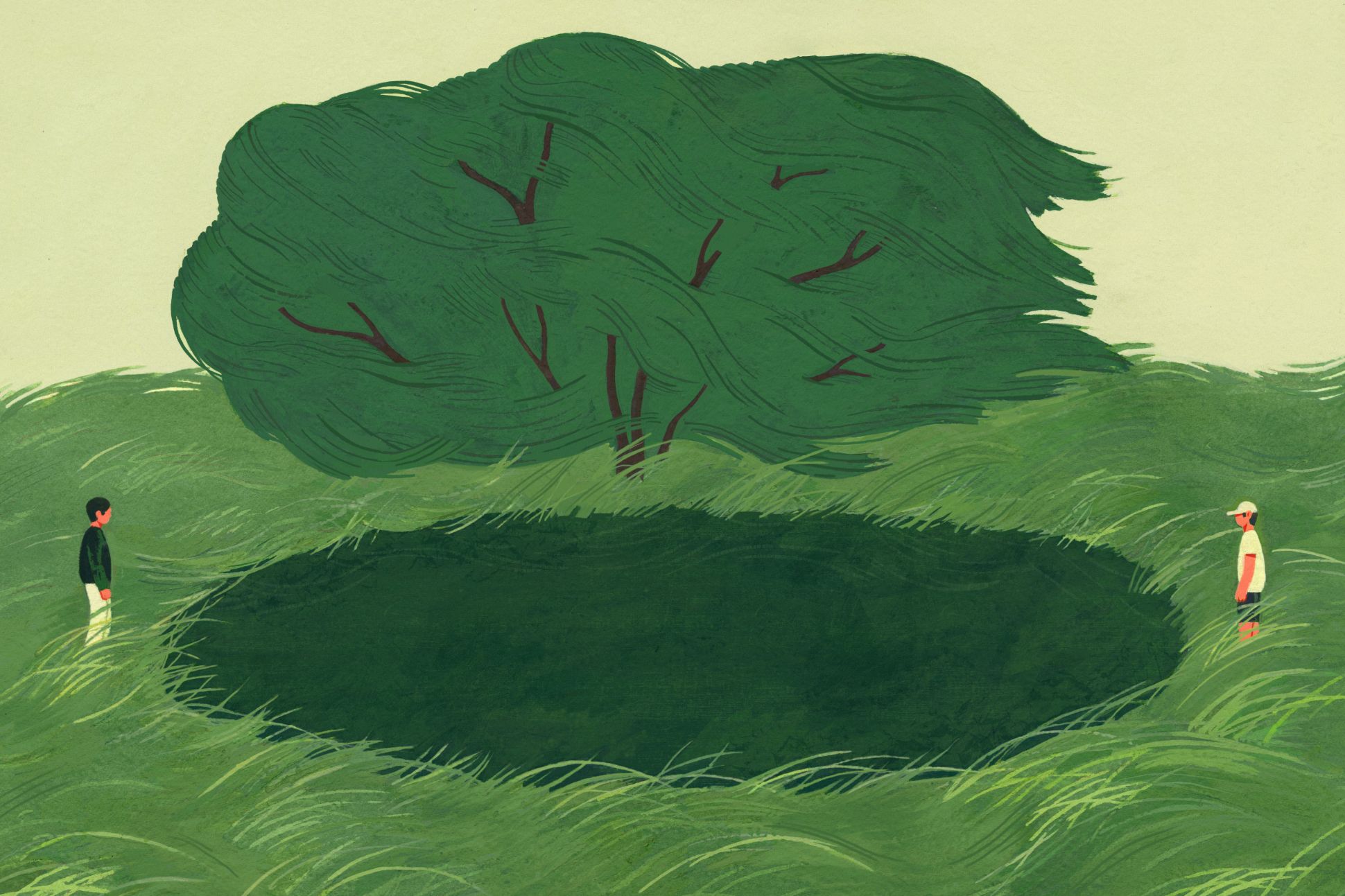
Art by Tilda Rose.
I try sometimes, as an exercise, to distill the story into as short a sentence as I can manage:
I survived a suicide attempt, and two months later, my brother died.
Two months before my brother died, I tried to kill myself.
I almost killed myself, then my brother died.
He died right after I tried to.
I'm here and he is gone.
In my memory, it all happened in the span of a sentence. I took the pills and woke up in the psych ward of the shabbier hospital in town, Good Samaritan, where I spent some days. An older woman, Barbara, a fellow patient, would come around now and then in her wheelchair and tell me I was “a prospect.” The windows were frosted, so light filtered in, but we couldn't really see out—couldn't tell how high up we were, how many stories. I argued with the head nurse, and as a consequence she added another 72-hour hold to my initial 72-hour hold. Daytime television streamed in the community room, the dull theatrics of courthouse drama.
This, too, is why I try to stick to one sentence, a poem at most—so many stray details, it's hard to know what's important to recount.
The day I got out, I had to call my mother for a ride. I was 23. She drove me to Starbucks. I changed into the clothes she brought, old basketball shorts and a T-shirt. My mother drove me to the lake then, the big lake on the farm where my siblings and I grew up. The dock was hemmed with fescue, an overturned canoe just visible in the tall grass, jutting out from beneath the rickety wooden planks.
My brother was there when we arrived, his sepia-colored Camry parked down the hill, his door slung open, one leg stuck out as he waited. It had been years, maybe a decade, since we’d last hung out together at the lake.
We didn't talk much about the pills I’d swallowed or the treatment center I was headed to up in Cincinnati—though I did tell him about Barbara, and together we surmised that by “prospect” she’d meant dating or marriage material, which was very funny to us. While my mother made a phone call in her car, my brother and I stood at different points around the lake, remembering. There was a low point in the undulant terrain where my brother, as a young teenager, fished in the summer. He and his friend Ricky would sometimes let me tag along while they smoked Marlboro Reds and reeled in these prehistoric-looking grass carp. Because they always released them back into the lake, they probably, on many occasions, caught the same stubborn fish.
We stood together on the dock from which, on one particularly hot summer night, we leapt into the dark, star-pocked water and swam out to the middle of the lake, struck by an eerie sense that some behemoth stalked our water-treading feet. I passed on the Copenhagen Long Cut when he offered it to me, though I wish we’d shared, one more time, that little ceremony, pulling out the lower lip, pushing into it the pinch of damp tobacco.
This moment by the lake—watching my brother take the dip into his lip and slide the little disc back into his rear pocket, the almost instant relief of nicotine washing over his face—calls to mind these lines from “A Moment” by Gregory Orr, one of the first poets I really loved:
One moment you're standing
shoulder to shoulder,
the next you’re alone in a field.
He's writing about the last moment he spent with his brother, just before a terrible childhood hunting accident that resulted in his brother dying right there in front of him. One moment, you are with, the next you are alone. It’s that simple, really.
Maybe I want my poem to focus here, on this moment: on my way back to life, my brother on his way out, ships passing not in the night but in broad daylight.
I guess you figured this out, he said—we’d stepped off the dock and were standing back in the tall grass—but you can't overdose on those.
He was talking about Klonopin, of which I’d swallowed a small handful. And in fact, I didn't know that—hence my standing there, existing. One would have to take considerably more pills to end themselves properly, a fact I’d verify later on Reddit and WebMD. We laughed about it. It was something only my brother could have said in that moment, my brother with his history of pills and IV drugs, a Herculean alcohol tolerance—after he died, the nurse told us that upon arriving at the hospital, my brother disclosed that he drank eighteen to twenty beers a day. If that's what he felt comfortable confessing, the number could well have been higher, this on top of his long hours at the lumberyard, his night shifts in back of an EMS van—he'd been training to become an EMT. I wonder when he had time to drink that many beers, and of course how his body managed to perform that much labor while processing that much alcohol.
I don't remember how we parted from the lake, what we did or said, only that when I left—when I got back into my mother's car and headed to the treatment facility in Cincinnati—my brother said he was going to stay for a bit. He took me in for a proper hug, then turned and headed back down toward the water.
***
Another poet I admire, Marie Howe, wrote a poem titled “The Last Time,” in her collection What the Living Do (1997), perhaps her most celebrated book. The poem recounts a moment between the speaker and her brother that takes place the last time they had dinner together in a restaurant before the brother died. The whole poem exists as a sort of semantic misunderstanding between the two of them, a misunderstanding that leads to a troubling realization:
“I'm going to die soon,” the brother says, “I want you to know that.”
And the speaker says she does know.
But what surprises the brother, he says, is that she doesn't know.
“I do,” she insists.
“What?” The brother asks—the exchange feels almost Seinfeldian.
“Know that you're going to die,” she responds.
And the revelation or realization or difficult surprise: “No,” he says, “I mean know that you are.”
We know from other poems in the book that the brother is dying from AIDS. But we don't really know what he means, explicitly, when he says the speaker is going to die soon—maybe that no one has as much time as they think they do, that the end can and will sneak up on a person.
My reading of this poem, and those final lines in particular, is overlaid with the sort of temporal confusion I’ve experienced since my brother’s passing, confusion—or, maybe, absolute clarity. I was 23 when my brother died; he was 28. There was the ubiquity of death, thereafter—as both an idea and as something actual, like a horizon—which had the effect of, at once, collapsing time and exaggerating it, throwing into contrast my brother’s relatively short life with my own unfurling future. And of course there was my thwarted suicide, the death I evaded, my proximity to the horizon my brother crossed just a couple months later.
I've also experienced strange thresholds and passages, minor paradoxes. My 29th birthday, for instance, marked my becoming one year older than my older brother. Did I still have an older brother? Do I now?
Two months after I saw him at the lake, my brother checked himself into the ER. I was by a different rural body of water—a friend’s family had invited me to spend Labor Day weekend at their home on the rocky mid-coast of Maine. It felt like a sort of reentry after treatment; I was two months clean and ready to re-engage with friends and, to a lesser degree, with the world.
For two days we swam in the brisk Atlantic water, grilled burgers and brats, read in low deck chairs in the shade. It wasn’t until my friend and I were tasked with a general store run that the stream of texts, missed calls, and voicemails barraged my phone, unleashed by my sudden resumption of cell service. Reading and listening to the messages in the car, I pieced together the play-by-play: your brother’s sick . . . your brother is in the hospital . . . your brother is in the ICU. Can you catch a flight? Can you come home? Please call. By the time I did call, they'd been waiting to give me a chance to say goodbye.
My mother held the phone to my brother’s ear. And, in the moment I had, I said what came to mind, and what I said will remain between my brother and me. But I can tell you that what I said fell short, the way all elegies probably fall short.
This poem I've been trying to write—the lake, the pills, the last time I saw my brother alive—is maybe the same poem I’m always trying to write. I'm sure others have experienced this: how everything, after a particular type of loss, is imbued with elegy. How morning light arrives too bright through the blinds, then is gone completely. Or how my dog at the foot of the bed, tail thumping the mattress, is a both a present comfort and a commitment to a future burial. I take the first sip of black coffee and am aware, even as the nerves thrill and the day’s aperture opens, that the feeling will end, and sooner than expected.
There seems to be a sort of tether between that moment—be it with my brother in the tall grass by the lake, or speaking my final words to him through the phone held to his ear—and the still undetermined moment of my own passing, between that moment and the hazy memory of opening my own eyes in the hospital, oxygen mask strapped over my nose and mouth, fluorescent ceiling lights relentless overhead.
***
I came only recently to the poem “Outgoing” by Matt Rasmussen. I wish I’d found it sooner. In it, the speaker is tasked with recording a new message on his family’s answering machine, overwriting the one left by his brother, who has just shot himself. He describes the little cassette tape inside the white answering machine as a “tiny [hospital] patient / being monitored or a miniature glass briefcase / protecting the scroll of lost voices.” I didn’t have this exact experience, but a similar one. After my brother died, I’d do this thing now and then where I’d call his old cell phone number. I wanted to hear his voicemail recording, like a sealed vial of his breath, that smoker’s timbre as he said, You’ve reached Matt Waldman. I’d dial the number, only a couple digits off from mine, and after he spoke, the machine voice would tell me that his mailbox was full, and I’d hang up.
It went on like this for a year. Then we disconnected his phone line; it didn’t make sense to continue paying the bill. But I continued calling—I don’t know why—only to reach a recorded error message: three ascending notes, then: we’re sorry, the number you have dialed has been . . . It was a ritual, I suppose, a way of confronting the fact of his absence.
I did this for ten years, until I suddenly stopped for no particular reason. Several months ago, on a warm summer afternoon in Brooklyn, I dialed the old number again—the number that, for whatever reason, had never been reassigned. The phone rang twice, then a man who was not my brother answered. I wasn't sure what to do or say—I’d never prepared for this outcome. He said “hello?” a couple of times while I stammered. He sounded older, closer to my parents’ age. After a few seconds of silence, he hung up.
I gathered myself and called back, maybe 30 minutes later, but he didn't answer. I learned from his voicemail greeting what his name was. There was the sound of the beep, and I addressed him by name. I just started talking, explaining why I’d called, emphasizing that I wasn’t asking for anything and wouldn’t call again. But I couldn’t hang up either. I told him that my brother was a drinker, that that’s pretty much what killed him, but also that I felt guilty sometimes, like maybe he’d gone on a bender because a couple months before he died, I had tried to kill myself, and that maybe I’d caused him to spin out and drink more than he would have otherwise. I heard how crazy I sounded, but I kept going. I told him my name. I told him my brother’s name. I thanked him. Then I put down my phone and went out for a walk.
While waiting to cross Gates Avenue toward the park, I received a text message from the man, which showed up under my brother’s name: Matty. I’d never deleted it from my phone.
that sounds hard, the man said—Matty said—best of luck to you.
What else could he say? What else was there? A scatter of dogwood blossoms on the sidewalk. The warm afternoon. The B69 bus exhaling to a stop. A little chain of young kids next to me, antsy, waiting to cross the street.
D.S. Waldman is the author of the poetry collection Atria (Liveright/WW Norton, 2026). His writing has appeared in The New Yorker, The Atlantic, Los Angeles Review of Books, ZYZZYVA, and many other publications. His honors include a NYSCA Individual Artist Grant, Poetry Society of America’s Lucille Medwick Memorial Award, and a Wallace Stegner Fellowship from Stanford University. Waldman lives and...