


A Man of Many Hats: Remembering Larry Sawyer
For Larry, poetry was the molecular music of life.
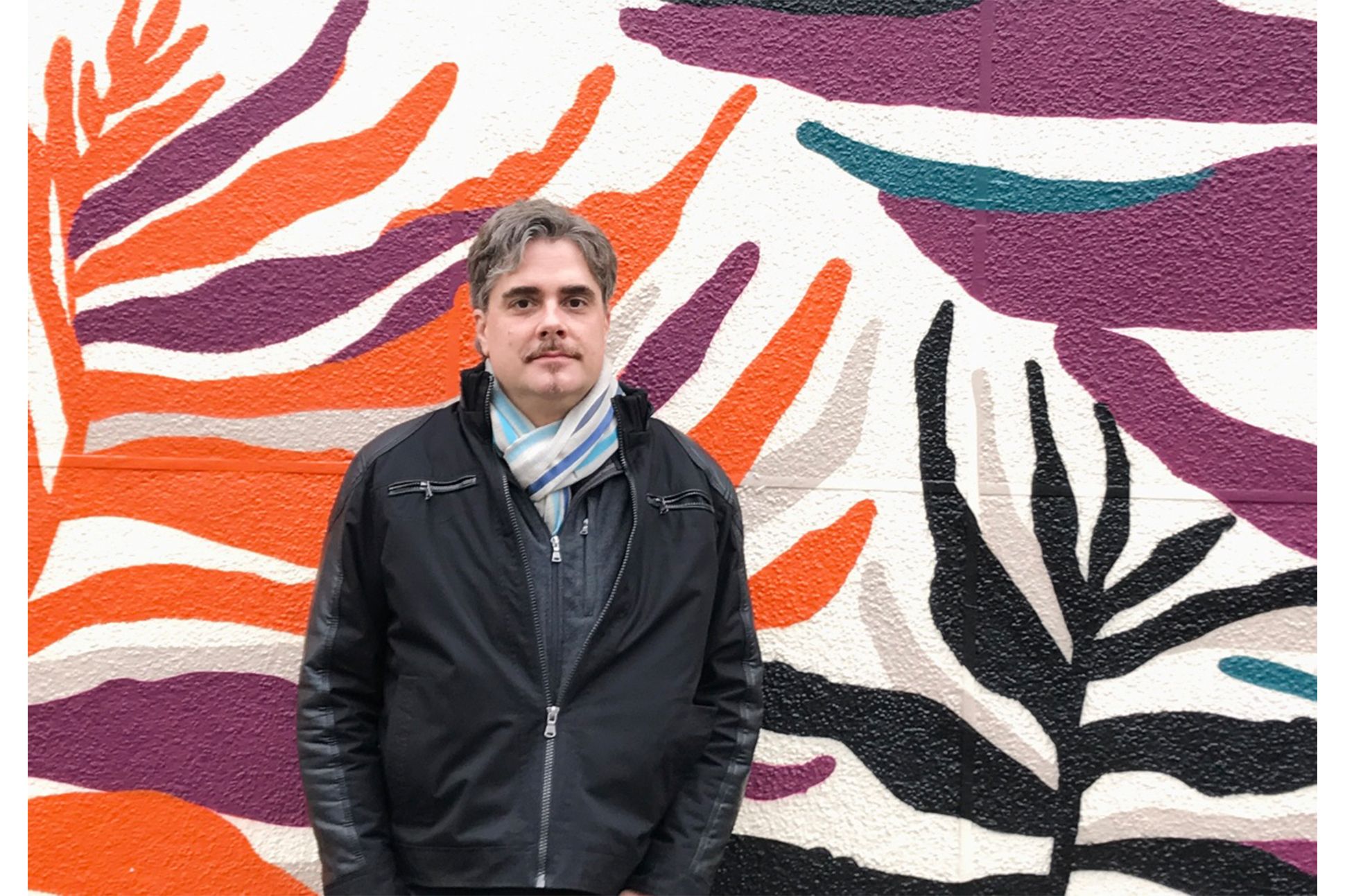
Photo courtesy of Lina Ramona Vitkauskas.
Essays in the “Remembrances” series pay tribute to poets who have died in the past year.
In February of 2025, the poetry community lost Larry Sawyer, a man of many hats who was, first and foremost, a poet. An accomplished editor of Nexus and milk magazine, a longtime curator and collaborator, and a relentlessly curious soul, Larry had an unassuming Midwestern mien that enabled him to effortlessly fit in just about anywhere, whether it be a poetry reading, bowling alley, film festival, political protest, or local bar. Blessed with a handsomeness and natural cool à la Steve McQueen, and an inexhaustible passion for music, particularly jazz, in a different timeline Larry might have been riding out some melodies onstage among the finest musicians. The path he chose, however, was poetry, and we’re all richer for it.
I don’t remember exactly when I first met Larry, but I do remember that around 2004 was when I first had the chance to sit down with him at length. He had arranged to meet poet, translator, and publisher Raymond Bianchi and me at an Irish pub in Forest Park, and the three of us talked about music, film, and, of course, poetry. It was clear to me then that Larry had a much deeper grasp of Surrealism than I would if I were granted five lifetimes, but a perhaps offhanded remark he made back then has stuck with me ever since. He casually offered, “I don’t know about you, but I’m not too attached to any one poem I’ve written.” As a Southside Chicagoan still trying to get my footing as a poet––and, as a result, bleeding every word choice and line break I made at the time––Larry’s comment was jarring, radical. In the moment, it prompted me to question my relationship to my own writing, but over the years I’ve come to see this approach as of a piece with his capacious, creative spirit. Long before terms like practice became fashionable, Larry was fully committed to living his life in daily renewal as a poet, riding his verses wherever they might take him. Or as he writes in “Critical Events in Anesthesia”:
The way a mythology
scrapes the
night sky
in the everyday
items so
important to you.
Not long after our first meeting, I was fortunate to receive a fellowship for my first-ever artist residency at Djerassi. While I was there, Larry reached out to me to solicit some poems for milk magazine, which he coedited with his partner, the poet and video poet Lina Ramona Vitkauskas. I initially tried to deflect the offer because I was working on things that felt very in-progress and raw. Eventually, I admitted as much to Larry and he insisted I send the poems anyway. That show of support meant more than Larry could know. It signaled to me his generosity as an editor who wanted to encourage space for poetic growth, experimentation, even the demo versions or B sides of the poetic songs that feed creativity. Looking at the back issues of milk, they are a veritable who’s who of different generations of poets, converging and diverging aesthetics. Poems by figures such as Allen Ginsberg, Robert Creeley, and Pierre Joris appear alongside those of others who were just emerging on the scene, poets like Daniel Borzutzky, Kerri Sonnenberg, Linh Dinh, and so many more than I can feasibly list here.
In 2005, Larry became the curator of the Myopic Poetry Series in Wicker Park, and about a year later he initiated a monumental reading in celebration of the archives of Poetry. This was before Poetry’s archives were fully available online, and so he made a pilgrimage, went through roughly 80 years of issues, and selected a range of poems spanning that time frame, then invited numerous poets, including me, to choose poems from the selection to read at the event. Larry beamed as he read several poems over the course of the evening, and I remember being particularly impressed by his choice of Marianne Moore, a poet whose work I hadn’t been able to connect with as a student. Larry’s inclusion of her poems at that event prompted me to revisit her work and my admiration for her has grown ever since.
Larry was a vortex of poetic energy, a tender tornado, and I think the Poetry event was his way of underscoring and celebrating the fact that the city of Chicago has been and continues to be a vital hub of American poetry. Shortly after that event, an anthology called The City Visible, which celebrated the vibrant poetry community in Chicago and the greater Midwest, was published by Cracked Slab Books. Naturally, Larry was among the contributors (others included Ed Roberson, Stacy Szymaszek, and Simone Muench). It’s difficult for me to imagine such an anthology having the necessary momentum were it not for the energy Larry fostered at Myopic, as well as other noted poetry series of the time, such as Danny’s, Red Rover, and the Discrete Series.
Larry wasn’t wired for naked self-promotion or transactional relationships; he was the sort of person who would politely excuse himself from a conversation at the bar only to return having bought a round of drinks for the table unprompted, and then enthuse about Japanese surrealist poetry or why he’s such a fan of Ron Padgett. He was always more excited to share what interested him rather than talk about himself, and his extraordinary generosity toward other poets, coupled with his inherent modesty, might risk overshadowing his poetic output. But if his editorial and curatorial efforts were a constant, so, too, were his poetic energies. He published numerous chapbooks, and his full-length volumes include Unable to Fully California, Vertigo Diary, Breaking Lorca, and Daylight Hammer. Vertigo Diary was a breakthrough book for me, and I immediately connected with Larry’s poem “My Sunflower,” so much so that I sometimes read it at the start of my own readings. The poem opens with a surprising conceit: “Why was each moment / such a miniature Troy?” For Larry, the scales of the intimate and epic were different keys in the same ongoing song, always an enjambment away.
After 15 years at the helm at Myopic, being named Chicago’s best poet by the Chicago Reader in back-to-back years (2012 and 2013), plus running the Chicago School of Poetics (together with Francesco Levato), he and Lina decamped to Toronto, with an eye toward new beginnings and adventures. Unfortunately, about a year later, he wrote me with the understated news that he had “to get a procedure done.” It was only later that I learned he was battling cancer.
While he was fighting for his life, he still made the time, incredibly, to initiate a new reading series, the milk magazine reading series at Type Books, and got to work on what will now be a moving posthumous volume, TheBlue Butterfly (forthcoming from Guernica Editions in Canada in 2027). The poems in The Blue Butterfly reflect a poet impressively attuned to his powers and circumstances, swerving around rhymes and tugging at our shared impermanence, or as he writes in “Apocalypse Beach Body”: “Anything to wow bomb the / existential quandary of physically melting.” His poetic awareness surfs between the domestic and the interstellar, Michael McClure meets R. Buckminster Fuller, as he writes in “Pandemic Pantoum”: “The bells of Sunday disappointed my imagination; / I was more excited by the planets, colorful ghosts above.” For Larry, poetry was the molecular music of life.
When I think of him now, I picture him dapperly attired for cosmic bowling at Waveland Bowl, throwing rocks with Lina, Kristy Odelius, me, and a roving group of friends, a post-game beverage at Crabbby Kim’s just ahead of us, his legendary laugh never in short supply. Larry listened attentively and waited his turn, but I don’t doubt for a minute that lines of poetry were riffing in his mind. He gave so much time, space, and energy to other poets that it’s only fair he gets the last word. In his poem “Why I Will Not Wear Lavender,” Larry could be conversing with Walt Whitman’s “When I Heard the Learn’d Astronomer” and smiling brightly as he “wow bombs” us with an instance of astral gratitude and amazement:
At that moment the sky winked
and our lives seemed somehow enlarged
and our guns shot only dandelions
and our eyes were
finally innocent diamonds
dumb with wonder.
Poet and translator Mark Tardi (he/him) grew up in Chicago, Illinois, and earned an MFA in creative writing from Brown University. His collections of poetry include The Circus of Trust (Dalkey Archive Press, 2017), Airport Music (Burning Deck, 2013), and Euclid Shudders (Litmus Press, 2003).
Tardi’s Polish heritage led him to an early interest in Polish poetry, and he was a 2008–2009 Fulbright Senior...