


We Live in Dark Times
On the poetry and activism of Breyten Breytenbach.
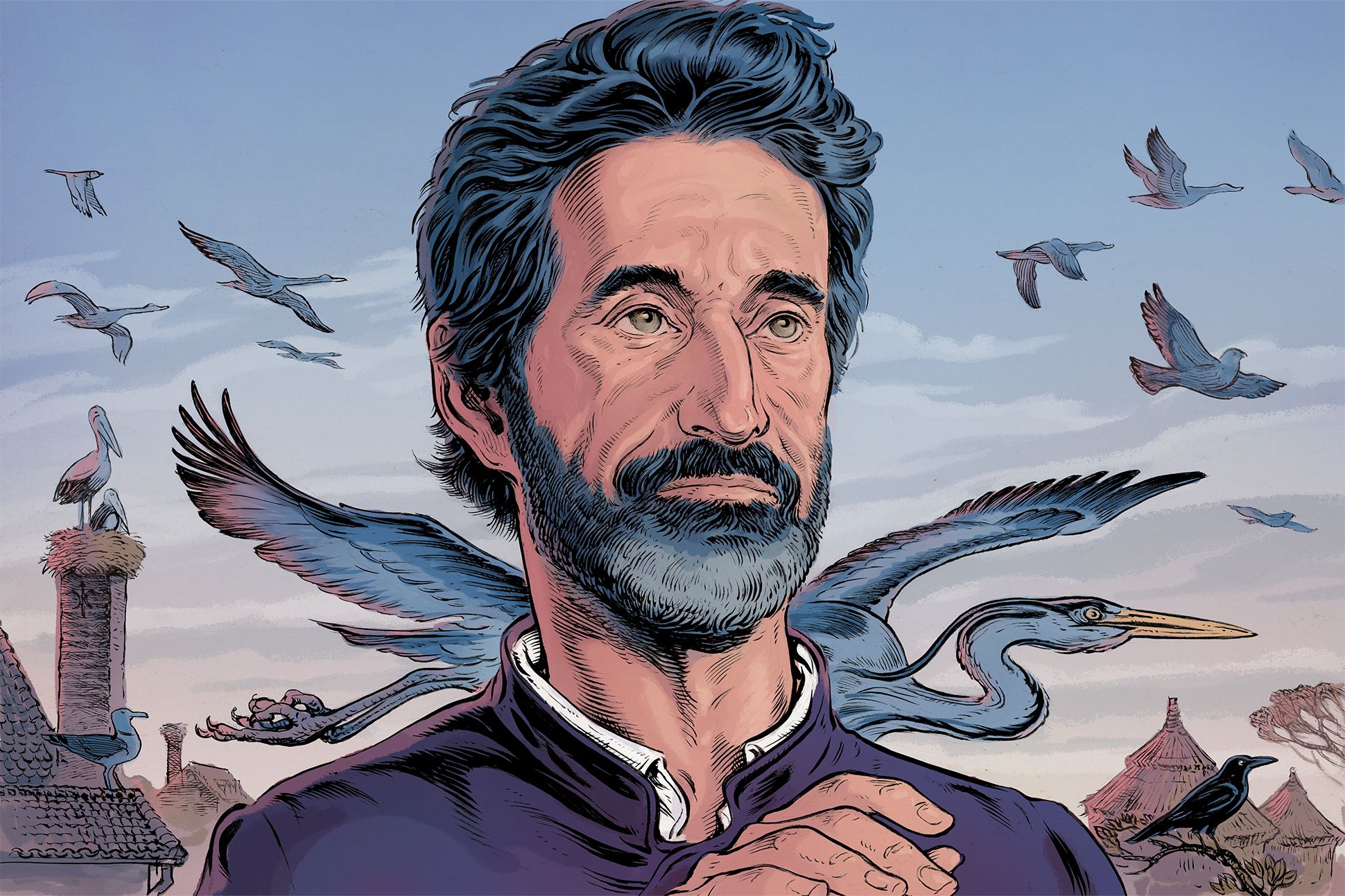
Art by Lars Leetaru.
I first met the South African poet Breyten Breytenbach in Paris in August 2008, outside the Shakespeare and Co. bookshop, just across the river from Notre-Dame. I was living in the bookstore that summer, one of the innumerable tumbleweeds that George Whitman and now his daughter Sylvia have selflessly hosted over the years. We blew in off the street and traded light labor for bunk beds that slid out of their hiding places when the last customers left at night, only to disappear just as randomly as we’d wandered in.
Memory plays tricks, but I remember Breyten in a bright red Nehru jacket. During that reading in Paris, he regaled the audience with a draft of “The Nomadic Conversation with Mahmoud Darwish,” his funerary elegy to his friend Darwish, the Palestinian poet who had died earlier that August on an operating table in Texas. Breyten had known Darwish for years, visited him in Ramallah, and had last seen him just weeks before his fateful procedure. The image of Darwish’s failing heart serves as the opening scene for Breyten’s elegy:
when you die, Mahmoud
when your aorta thrashing
like a purple snake bursts
because the lines can no longer
carry the perfect metaphor
and your heart as poem spurts
the final blood
in that hospital in foreign parts
of the barbarian land,
when your heart at last
could be a wingless bird
Where should the birds fly after the last sky? Darwish asked in one of his better-known poems, and not long after his death, Breyten employed that question to explore a radical new cosmopolitan geography he called “the Middle World,” which constituted a “finality beyond exile”:
For a while at least the reference pole will remain the land from which you had wrenched yourself free or from where you were expelled. Then, exile itself will become the habitat. And in due time, when there’s nothing to go back to or you’ve lost interest, MOR [the Middle World] will take shape and you may start inhabiting the in-between. The terrain is rugged, the stage bathed in a dusty grey light. It is not an easy perch.
Breyten defined the Middle World as “somewhere equidistant from East and West, North and South, belonging and not belonging.” He refuses to pin it down. “I don’t have a complete topography because cities and countries may change their colouring on the map and the forces of conformism are voracious.” Notwithstanding its blurry (non)boundaries, Breyten tells us that “wherever its uncitizens are, there the Middle World is.” These uncitizens move about and change colors to suit their environment, like their emblems, the parrot and the chameleon. The Middle Worlder transcends physical borders as well as psychological ones and will “practice nomadic thinking, even if he doesn’t move around much.” The Middle World is also a space where the mind is free from nationalistic attachment, where shifting personae come and go with the wind, like birds.
Soon after our first meeting, I traveled back to Paris to interview Breyten for the British magazine PN Review. Following the end of that conversation, he handed me the proofs for his latest collection of essays, Notes from the Middle World (2009), and called me a Middle Worlder. I’ve been trying to find my own uneasy perch ever since.
***
Sylvia had suggested I read a poem or two to open for Breyten’s reading, and I devoured his books in advance of his visit, starting with his prison memoirs. Who could resist a title like The True Confessions of an Albino Terrorist?
As related in the Confessions, Breyten’s arrest, prosecution, and incarceration in the 1970s and early 1980s is one of the most bizarre episodes in the hideous history of South African apartheid (1948–1994). Born to a farming family in the Winelands east of Cape Town in 1939, Breyten briefly enrolled at the Michaelis School of Fine Art, but a year and a half in, and without telling anybody, including his family, he boarded a ship for Europe, and began a self-imposed exile that would last nearly 20 years. After roaming the continent for a while, he was 22 when he made Paris his new home, and very quickly established himself as both a promising painter and the most celebrated living Afrikaans poet, a leading member of the Sestigers, or Sixtiers generation. Then, in 1975, more than a decade after the UN General Assembly condemned apartheid and called for sanctions against South Africa, Breyten upended his comfortable life in Paris, and set out for the land of his birth, wearing a disguise and using fake travel documents.
His aim? To establish an anti-apartheid movement, although his “covert activities” amounted to a few meetings—including with Steve Biko, a few years before his murder made global headlines and defined a generation—and distributing propaganda pamphlets, most of which were scooped up by the secret agents who’d been tailing him as soon as he’d landed back in South Africa. Breyten admitted as much in the Confessions: “My going, my being there, was contrary to all principles of underground organization.” Although the authorities fully realized they were dealing with a harmless poet playing at revolution, they charged him with terrorism, tortured him, and paraded him through a series of highly publicized show trials. Despite the lack of evidence, state prosecutors claimed that Breyten was one of South Africa’s most dangerous public enemies. They said he had established a network of armed terrorists, and had even obtained a Soviet submarine to storm the prison on Robben Island to free Nelson Mandela. They dangled the death penalty before slapping him with a nine-year prison sentence. He was mostly forbidden to write, but they gave him a window with a view in solitary, right next to death row, where he watched dozens of men hang each month.
The apartheid regime delighted in tormenting Breyten Breytenbach, all at the explicit urging of the country’s then prime minister, John Vorster, a Nazi sympathizer, to whom Breyten had addressed one of his most famous poems, “letter to butcher from abroad”:
and you, butcher,
burdened with the security of the state
what are your thoughts when night begins to show her
skeleton
and the first burbling scream is forced
from the inmate
as if of birth
flooded by the fluids of parturition?
[...]
does the heart also tighten in your throat
when you paw its slippery limbs
with the very hands that will caress the secrets of your wife?
They made him apologize for that poem during one of his trials. Truth stings hardest when you hear it in your own accent, and Breyten’s betrayal had struck at the heart of the regime. While South Africa had grown accustomed to international condemnation for its treatment of non-whites, the Breytenbachs of Bonnievale were solid Boer farming stock from the Afrikaner heartland where the language itself had been born. Breyten’s older brother, Jan, was the country’s most decorated soldier, founded South Africa’s version of the Green Berets, and had led commando units in the war against Angolan and Namibian independence. Another brother, Cloete, worked as a war reporter and had deep connections to South African intelligence.
All of this made it impossible for the apartheid regime to dismiss Breyten as an outsider; in fact, he knew their language and history better than anyone, and even worse, he forced people to listen. Exploiting his fame, he had used every available opportunity to call out supporters of apartheid as “cowards,” “the mortification of Africa,” and perhaps most importantly, “bastards.” This is an excerpt from a talk he delivered at the University of Cape Town a couple of years before he was arrested, and which made headlines nationwide:
We are a bastard people with a bastard language. Our nature is one of bastardy. It is good and beautiful thus. […] Only, we have walked into the trap of the bastard who acquires power. In that part of our blood which comes from Europe was the curse of superiority. We wanted to justify our power. […] We made our otherness the norm, the standard, and the ideal. And because our otherness is maintained at the expense of our fellow South Africans—and our South Africanhood—we felt threatened. We built walls. Not cities, but city walls. And like all bastards—uncertain of their identity—we began to adhere to the concept of purity. That is apartheid. Apartheid is the law of the bastard. (emphasis added)
***
Birds were central to Breyten’s poetics. In his philosophical prose poem, “The Memory of Birds in Time of Revolution,” he defines light as a “precious commodity,” and birdsong, he says, reminds us not to waste it:
It is the nature of birds to be answering machines. When you telephone a thought to an absent friend, or a dead one, or one who is making love—the bird tells you to speak after the beep. Why is there so much light? It must be because we are living on the edge of the world, being set ablaze by the sun. When we dream, there are sparks streaking the vaults of infinity. Or maybe there is a revolution somewhere just beyond the definition of perception, so ardently desired and of such transformational importance that it lights up the skyline.
In Breyten’s poems, stars perch on rooftops like seagulls, lovers take wing and fly over dark times, and memories fade in and out of view like flocks of geese. Voice Over: A Nomadic Conversationwith Mahmoud Darwish interweaves Breyten’s original lines with fragments of translations from Darwish’s work, allowing their voices to harmonize while retaining their distinctiveness, nonetheless underscoring their shared penchant for supple tonalities, full-blooded images, and abstract musing. Breytenbach even turned the people he knew into birds, and Darwish was one of various artists that Breyten referred to as “birds of paradise,” as he did in the poem “For Michael Fried, Paris, 21 December 2004”:
we live in dark times
birds of heaven are poisoned
we roam through brightly lit halls
stare myopically at exhibitions
of grey imaginaries, encyclopaedias of passing
meticulously annotated absences of sensethe emptier the contents the more painful
perfection and the perfidy of looking will flow
as the world completes itself through us
and we see corpse camps, genocide, man
abjuring his skein of belonging
in a desperate wing-beat to be
free of death
the birds of heaven are poisoned
and we live in dark times
Soon after we met, Breyten and I began corresponding, a slow but steady trickle of poems, emails, and forwarded articles that would last until his death in 2024. Among the earliest emails I received from Breyten is a draft of his open letter to Nelson Mandela, which was eventually published in the December 2008 issue of Harper’s. In the style of his Middle-Worlder confrère, Émile Zola—j’accuse!—Breyten charged the ANC’s leaders, chiefly Mandela and Mbeki, with having betrayed many of the promises of reconciliation made at Dakar, where he had met many of them in person, including Mbeki, Mandela’s successor as president of South Africa. The dream of freedom, Breyten charged, had been stymied by crime, corruption, and greed, and despite having been founded on the world’s most progressive constitution, too many of the iniquities of apartheid had persisted into the new South Africa, and in many senses deepened. The old jailbird wondered:
Did you, did we, ever seriously intend to bring about a democratic dispensation in South Africa, with its checks and balances and accountability? Or was it about settling old colonial scores? For how long can we continue on the schizophrenic knife edge between the discourse of equality and justice and the practice of plundering and arbitrary power? For how much longer can this double-talk be sustained, to the population and to the outside world? Your mongrel son, Mshana
—Mshana meaning “nephew” in Mandela’s language, isiXhosa.
***
Breyten’s various personae recur throughout his work, and I became familiar with names like Ka’afir, Don Espejuelo, Jan Afrika, Jan Blom, Breyten Breytaintain, B. Breytenmud, Breyten Barkoutside, the Albino Terrorist, and Mshana, to name only a few. They fade in and out of his poems, memoirs, novels, articles, and paintings, constantly questioning, undermining, and ridiculing the lyric “I,” sometimes making even his grandest, and most grounded, political statements and analyses seem somewhat ethereal. While Fernando Pessoa’s heteronymous invented identities lived on the page, sliding in and out of the drawer at their master’s whim, wholly separate from Pessoa’s real life, Breyten actually lived his out, like Christian Galaska, the name he used in 1975 when he snuck back into South Africa to bring down apartheid.
Twelve years after he was arrested, and only five after he was released from prison, the Albino Terrorist hosted a peace conference on the island of Gorée, off the coast of Senegal’s capital, Dakar. Once West Africa’s premier slaving port, ergo its Dutch name, goede ree, or “good anchorage,” Breyten had chosen Gorée as the venue for the Dakar Conference of 1987, which brought together progressive Afrikaners and ANC leaders. The delegates in Dakar knew that apartheid’s time was up, but the real question was whether it would end in a peaceful, negotiated settlement or bloodshed. Many predicted outright civil war.
Breyten gambled that the horrific sight of Gorée’s dungeons would inspire delegates to lean toward peace. I have often wondered what those delegates—veterans of one of the 20th century’s most brutal racial justice struggles—would have made of their host. Breyten was tall, strikingly handsome, and delivered the harshest of comments in the supplest of tones—fitting, since he was also an ordained Zen Buddhist journeyman. It was all very unlikely, yet somehow it worked. The Albino Terrorist helped steer his country away from civil war. Less than seven years later, South Africa’s first free elections in 1994 brought Nelson Mandela and the African National Congress (ANC) to power, where it remains. Formerly one of the world’s most reviled pariah states, South Africa turned into a global success story, at least for a little while.
All this might help explain (yet another!) nickname Breyten earned: the “Only Nice (White) South African,” a title given to him by the writers of the British satirical show Spitting Image in their smash-hit satirical ska ballad, “I’ve Never Met A Nice South African,” where the singer tells us that he’s seen everything our world has to offer, including “unicorns in Burma and a Yeti in Nepal,” but that he’s “never met a nice South African”:
And that’s not bloody surprising man
Because we’ve never met one either
Except for Breyten Breytenbach
and he’s emigrated to Paris.
Yes, he’s quite a nice South African
And he’s hardly ever killed anyone
And he’s not smelly at all
That’s why they put him in prison.
***
Weeks after we met, Breyten sent me a text he’d written about his final meeting with Darwish, when they’d read poems together in the Roman amphitheater of Arles in southern France. “Mahmoud is gone. The exile is over. [...] There will be eulogies and homages. He will be ‘official,’ a ‘voice of the people.’ [...] He knew all of that and he accepted it, and sometimes he gently mocked the hyperbole and the impossible expectations. Maybe the anger will be forgotten. Maybe even, the politicians will refrain from trying to steal the light of his complex legacy, his questioning, and his doubts, and perhaps some cynics—abroad as well—will, this time, not disgust us with the spectacle of their crocodile tears.” No tears, then, reptilian or mammalian. He is gone, and that is that. As Breyten says at the end of “The Memory of Birds in Times of Revolution,” he has smoothed his feathers, gone to bed with a memory of light, and continued dreaming. After all, his flight to eternity was planned, and meticulously executed. Breyten’s final work, a verse drama entitled Verwelkingslied, or Swan Song, written just before his death and performed not long after, pits an aging actor talking to a dead poet, Breyten himself.
André Naffis-Sahely is the author of two collections of poetry, The Promised Land: Poems from Itinerant Life (Penguin UK, 2017) and High Desert (Bloodaxe Books, 2022), as well as the editor of The Heart of a Stranger: An Anthology of Exile Literature (Pushkin Press, 2020). He is from Abu Dhabi but was born in Venice to an Iranian father and an Italian mother. He also co-edited Mick Imlah: Selected...