


The Party Goes on Forever
For the beloved queer trickster Kevin Killian, pop culture was always entangled with death.
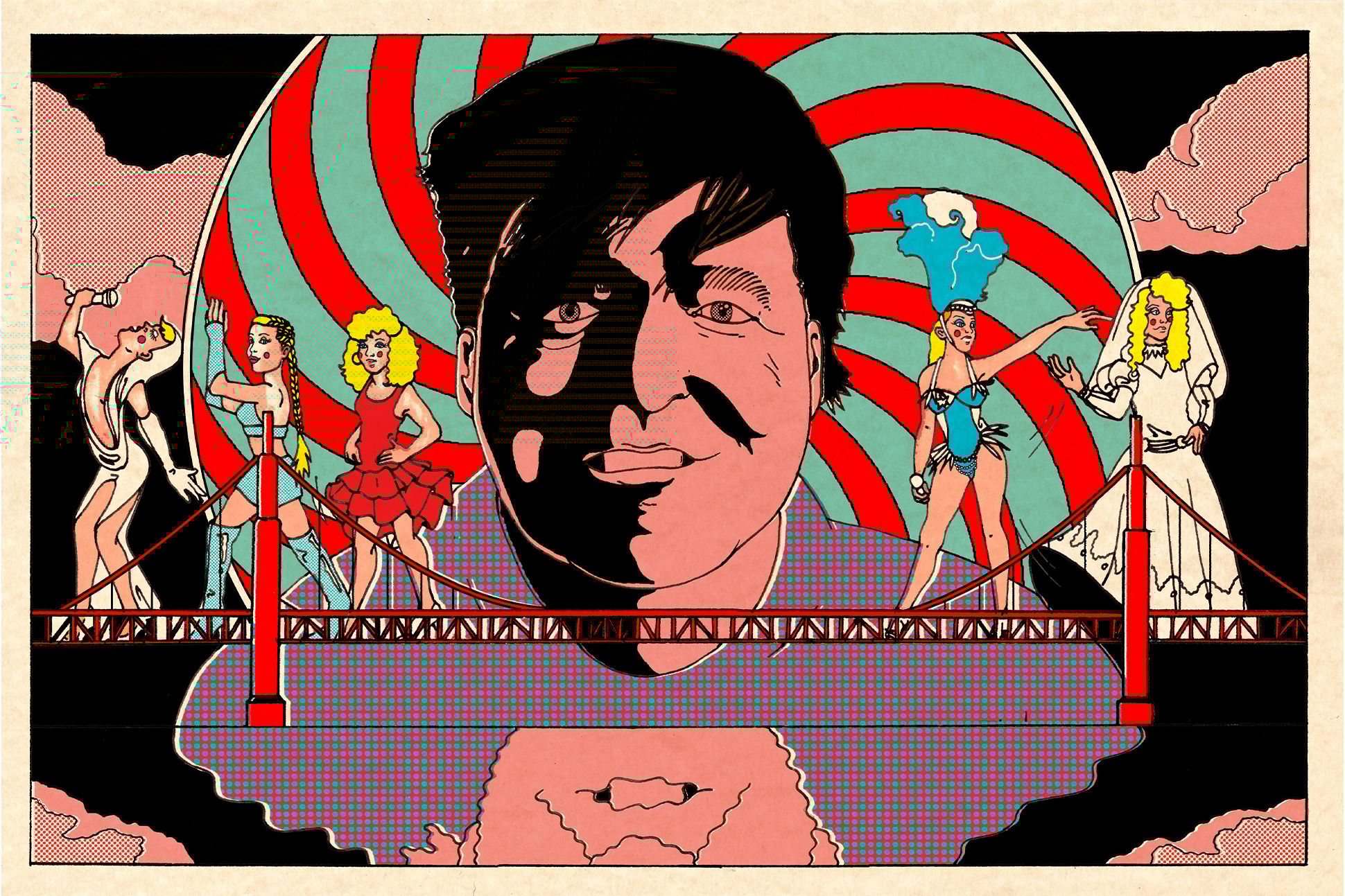
Art by Stella Murphy.
The title of Kevin Killian’s collected poems is a wicked little joke. It’s about his love for Kylie Minogue, the Australian pop diva who has for decades stolen the hearts of gay men. Minogue boasts countless megafans, but the late writer may have been her biggest. She appears constantly in his poems—what animals were to William Blake, angels to Rainer Maria Rilke, or broken hearts to Dionne Warwick, Kylie Minogue was to Kevin Killian.
The jest: Editors Evan Kennedy and Jason Morris named Padam Padam (Nightboat, 2025) for Minogue’s global smash hit of the same name, but Killian never heard the track. It came out in 2023, four years after he died of cancer. If such an anachronism feels irreverent, even impertinent, it’s also so totally him: an impishly profound reminder that our society’s obsession with mass culture is tangled in a fixation on death.
Killian lived many lives before he published his first volume of poetry, The Argento Series (2001), when he was nearly 50. He was a childhood spelling bee champion; an alcoholic English masters’ student; an underknown novelist (Shy, his 1989 debut, is desperately in need of a reissue); and an accomplished memoirist whose short account Bedrooms Have Windows (1989) dug into a frantic youth on Long Island. (Killian was born in the Suffolk County enclave of Smithtown in 1952.) After a move to the Bay Area, he met his wife, the writer Dodie Bellamy—both were queer, and Killian slept primarily with men—and supported his literary endeavors for almost four decades as a secretary at a janitorial firm. He became a mainstay at the San Francisco bookstore and community space Small Press Traffic, where he developed his style and came to define the city’s genre-agnostic, defiantly autobiographical New Narrative Movement.
Killian also founded the second iteration of the San Francisco Poets Theater, a platform for avant-garde playwrights to put on transgressive, heady productions with non-professional actors. He frequently directed and performed in his own plays, which were madcap pop cultural exegeses that paired disparate figures, such as Julia Roberts and philosopher Giorgio Agamben. But it was The Argento Series, the first of five chronological books in Padam Padam, that established the dynamics on which his greatness hinged and raised the stakes for every artistic project that followed. In these poems, culture is the lens through which survivors understand their own desolation—what it means to keep playing your part after the credits roll.
The book is based on the filmography of Italian giallo master Dario Argento, whose gory flicks of the 1970s and ‘80s, most famously Suspiria (1977), are as atmospheric as they are brutal. Writing immediately after the peak of AIDS deaths in the United States, Killian saw the extended terror of that virulent period—a 15-year waiting room packed with a whole community expecting a fatal prognosis—mirrored in Argento’s tense pacing, the inevitability of his characters’ grisly deaths, and his camera’s fascination with blood. Argento’s gruesome visions spoke to those for whom every speck of red seemed like a pathogen. Killian wrote in “Perche Quelle Strane Gocce di Sangue sul Corpo di Jennifer?”:
January 3rd or 4th, I’m so sure, 1998 and a
black night in San Francisco
Why did Peter tell Steve and Jennifer I lived
miles from the Museum, is he trying to
Destroy me? What are those strange drops
Of blood on the body of Jennifer?
Pop culture pried open Killian’s trauma and his joy. Here was a post-camp voice, fluent in the snarky ruses of midcentury gaydom but unwilling to smirk in the face of cruelty. He worries about losing his flesh “in liver strips” in one stanza of “Goblin,” a poem that begins with a quote from Charles Watts, the unsung late San Francisco poet. What we presume to be a dirge turns dippy when Killian spins the surname into the line, “Watts up Charlie Chan?”
Another literary monument, “The Phantom of the Opera,” delves into the life of Matthew Shepard, a gay University of Wyoming undergraduate who was tortured and murdered by two fellow bargoers in 1998: an incident that shocked those sheltered from homophobic violence. In the subsequent media swarm, which questioned how sexual orientation contributed to the killers’ choice of a target, Killian saw a kind of social amnesia, a denial of gay suffering he links to the gaslighting common in horror cinema. So often in these movies, supporting characters dismiss the fears of victims—who are haunted, pursued, and at risk—and treat them like hysterics. Killian directs his fury at an actuarial diminishment of AIDS’ toll: “AIDS deaths dropped in half in 1997, now only the 15th killer / in America” and finishes with a comma that lands like a mic drop: “the corpses change but the party goes on forever,”
***
Killian embodied many of the transitions of another fin de siècle—between archness and earnestness, a literary culture and an audio-visual one, the analog and the digital. Killian memorized poems; he was a pre-Google fount of info. He was also one of the most prominent Amazon reviewers in the site’s history, a project he commenced shortly after a heart attack in 2003. (His Selected Amazon Reviews was published to deserved fanfare in 2024.) The exercise began with necessity—brief bonbons he managed in a compromised, medicated mindset, on sundry products such as a “Spa Experience Gift Basket,” Hitchcock’s Rebecca, and a makeup kit called the “Multiple Orgasm Set II.”
Killian wrote for professional publications, artists’ monographs, and bohemian zines, but he was never better than when moonlighting as an amateur critic. His nearly 2,400 Amazon reviews are unexpected opportunities for erudition that sometimes take the form of short stories or sinuous, emotional forays, equally trenchant and staunch in their appreciation for the flotsam and jetsam of American consumerism. He grieved celebrities’ deaths—often actors, from Anne Bancroft to Rodney Dangerfield—long before this was a social media ritual. He used a corporate platform to excavate the dustiest parts of the profligate, suburban postwar era; for Killian, as for so many, being online was a way to rustle up objects that exist in a wall-to-wall-carpeted basement somewhere in our national sprawl.
He put all of culture on the same plane, a reflection of the internet’s breakdown of traditional hierarchies, which he predicted just before this large-scale cultural shift became obvious. His poems from the aughts charted these currents in his own taste. For instance, he didn’t even like Kylie Minogue when he began to write about her—she seemed like a vapid, white screen for any meaning he might want to project. While working on his second poetry collection, Action Kylie (2008), Killian began to explore Minogue’s music and concluded that she was “the world’s greatest entertainer,” as he told Philadelphia Magazine. The superlative may have been tongue-in-cheek; the adoration was real.
Action Kylie is a giddy collection. Killian, whose existence felt more tenuous after his heart attack, redoubled his devotion to a culture intent on disposability. He includes, as a found poem, fake credits that were passed around on internet message boards for a rumored yet never released Minogue record, City Games. The very title “Action Kylie” sounds like something you can buy in a toy store, molded from plastic and with accessories sold separately. In Killian’s hands, Minogue’s importance isn’t a function of iTunes sales (or, now, streams)—she’s a whole fan club, with Killian licking the proverbial stamps as he sends everyone their official membership cards.
The poems themselves are commentaries on life as a walking encyclopedia at the dawn of an era when everyone would soon carry a palm-sized one in their pocket. Killian’s vast, idiosyncratic knowledge lends his fandom a curious detachment, a sense that he’s performing even as he inhabits it. “Never mind the bollocks / here’s Kylie Minogue,” he writes in “Heavy Handed,” anonymizing both the pop singer and the Sex Pistols’ quintessential punk LP. He name-drops Robert Palmer and Nick Cave, but offers no clues; are they the musicians, the critic and the artist, or all of them at once? He loved people whose names rhymed across eras—the aforementioned Charles Watts could have been so many people, perhaps most obviously Charlie Watts, longtime drummer of the Rolling Stones.
Killian’s knack for trivia reverberated because he recognized that proper nouns often make everyday speech dull with received meaning. The titles of each poem in Action Kylie are a prompt to reshape the familiar— “Hymn,” “Anagrams,” “Proverbs,” “Ode To Walt Whitman.” None of the lines in “Proverbs” are common sayings, but they make a statement about what an entertainment-obsessed society considers proverbial. “Mind, like parachute, / only function when open,” he writes, his askew grammar an allusion to the aforementioned Charlie Chan. The Lorca-referencing “Ode To Walt Whitman” casts a 19th century legend as a fantastical piece of trade: “And hello, hi, Walt Whitman, sleeping soundly with Rock Hudson, / with your long cruel hair wrapped tight around his pole.”
And then, poking through the fun like stuffing underneath a couch, Killian reminds us that his poetry emerged from an elegiac span in his own life. For example, “Cat Scan”:
What’s a cat scan, anyway?
you lie on your back, flimsy gown of paper,
and a cat walks down your body,
your forehead, your throat, sternum, stomach
and so forth, til the tiptoeing creature stares
back at you over his shoulder.
Kevin, plan to die.
***
Killian wrote like someone who had made these end-of-life arrangements before—as a heavy-drinking young man, a potential HIV sufferer, a patient in the aftermath of a coronary—and now he was exhorting his readers to stay alive. Tweaky Village (2014) abandoned the tight concept of Action Kylie, but anyone who has spent too much time on Grindr will recognize the root of its themes: Crystal meth, which contrary to popular belief slips through every social stratum of the gay community. This drug—understood by the non-promiscuous to be the province of Breaking Bad, not coastal, urban queer life—keeps users horny for hours and makes them seem, to sober partners, repetitive, possessed as though by demons, and entirely unaware of those around them.
Killian was astonished by how quickly the substance swept through San Francisco’s Castro District, and Tweaky Village was a means of bearing witness. He references meth explicitly, twisting the language of a local anti-drug campaign in “I Lost ME to METH.” But he also channels the drug’s effects more obliquely, rendering familiar figures in macabre tones—like the filmmaker George Kuchar, whom he describes as “a human Slinky”—and merging sex with self-mutilation. In one poem, a speaker circumcises himself and ends up injured with “a smaller dick but with more self- / satisfaction.” In another, a character based on Killian’s wife discusses “KO sex”—short for knockout sex, in which you imbibe four Ambien and fuck before passing out. Killian’s work was always more open-ended than allegorical, but it wouldn’t be a stretch to read this poem as a metaphor. Crystal, as Shakespeare once wrote about alcohol, “Provokes the desire, but takes away the performance.”
Killian was hardly a scold. He made light of society rather than expose or exploit amphetamine users. His art demonstrates a concern for humanity that also played out in his life. Before I knew Killian as a writer, I knew of him as a mentor—sadly, we neither met nor corresponded, but friends of mine sent him letters and manuscripts, to which he replied with enthusiasm that suggested belonging to a creative world was the height of earthly experience. In her introduction to Padam Padam, poet Kay Gabriel writes that “Killian made the people around him feel like the stars of stage and screen whose autographs he collected, as if he was your fan, and not the other way around.” Killian held the door open for those trying to bust into the literary world, and he and Bellamy also maintained friendships across large age gaps, one reason he wrote about culture as it mutated without siloing himself in a particular generational perspective. Killian queered aging: the past grew longer with memories, dead loved ones, and fading idols, but he filled his life with new confidants, allowing their influence to keep him invested in the present.
Because his memorial poems follow expressions of sorrow with defiant jokes and cheeky references, they bear an optimistic awareness that every loss occurs against the backdrop of a vibrant and expanding culture. Atrocities rupture this process—the war in Iraq; epidemics both narcotic and viral; gentrification; and in “Cobalt II,” from his final collection Elements, the enslavement of Congolese children to mine the titular metal. But Killian’s work expresses a faith that living and writing with a spirit of generosity can contextualize death within the collective, instead of disappearing each survivor into the black bag of the self.
Poems about the passing of English electronic musician Peter “Sleazy” Christopherson and the trans martyr Gwen Araujo are beautiful, homemade shrines, scribbled with inside jokes that Killian shared with both his subjects and the pop-cultural brain trust: “Gwen, / named after Gwen Stefani, no doubt,” he wrote about Araujo. His fourth collection, Tony Greene Era (2017), ends with “Exhausted Autumn,” a poem dedicated to the painter and photographer Tony Greene. In this gem, Tony wilts from AIDS, “Names dissolve into rhymes” and bodies Killian once knew fade into a city dead-set on remaking itself into a sleeker, more sterile image. Then the author leaves us with a finale that elevates his melancholy, humor, and shaken sanguinity all at once. Absurdity is a sign of resilience:
The big space that held your works, now privatized, a bank of condos,
On the back of your trunks, sagging across your butt like a scaffold,
Beautiful name that once spelled the future
***
Killian had not yet received his terminal cancer diagnosis when he wrote Elements, which appears in the US for the first time as the final section of Padam Padam after being published in a bilingual edition by French publisher Joca Seria in 2017. The poems have a conceit so basic they may jolt Killian aficionados: each is named for a different entry in the periodic table. The editors moved four of the inclusions that originally appeared in Tony Greene Era into this final section and added seven previously unpublished poems to the version published in France. All this rejiggering reminds me of some mid-1960s LP, its track listing switched up when it crossed the Atlantic and arrived on shelves stateside. Such a Killianesque gesture fits on another level, too: Elements, more than any of his other collections, looks back at the world of childhood, intercutting his ordinary playfulness with vivid familial scenes. He writes, in “Lead”:
—as, in the middle of the sixties, my dad stood by silently on the
outside of the track while I ran the 100 yard dash
I didn’t come in last exactly, but my short legs never get me
anywhere
He wouldn’t embarrass me in public, but on the way home in the VW
he said, “They call it a ‘dash’ for a reason.”
Later in this poem, Killian writes, “When did he die? I didn’t even remember, but he was better off, for I / made him angry with my ways.” Nightmares of youth hound him half a century later, as in the overture “Table of the Elements”:
You could throw it and it would stick to the wall like when pasta is
done, said my dad, as in dreams the dead come and animate your
bones once again
These gutting poems, written when Killian was in his sixties, feel like the late work of a great artist with limited time who arrives at a more concentrated understanding of his own practice. Killian simplified concepts and heightened emotions, working with the building blocks of chemistry instead of the tangled skein of contemporary life. The old alchemy is all there—one line of “Titanium” discusses both the 2016 shootings at the Orlando queer nightclub Pulse and the eponymous 2011 hit by David Guetta featuring Sia—but a different dimension has been allowed to enter, which shapes his verse with the barest traces of sentimentality. This reframing in the final act gives the entirety of Padam Padam an arc, from a haunted game Killian plays with calamity and cultural ubiquity in The Argento Series to experiences from childhood that leave an imprint, the foundations of our connections with other people. One wonders where Killian would have gone next, but this stop on his journey serves as an eerily perfect resting place.
If mortality shaded his final 20 years, when Killian produced each of the books in Padam Padam, it was also a false deadline, which he constantly conveys while writing about the dead. His poems could end anywhere—a reason why his corpus pushes past neat conclusions and tidy messages into an indeterminacy that seems now like a beacon of hope. Killian’s verve has become more potent since his expiration date. He would never let tragedy get the last laugh.
Daniel Felsenthal is a critic, essayist, poet, fiction writer, and experimental DJ whose work has appeared in The New Yorker, The Guardian, The Atlantic, The Nation, The New Republic, Los Angeles Times, and many other publications and anthologies. He teaches creative writing at Columbia University and is one half of the music-poetry duo 3 People.