


Language a Wood for Thought
Susan Howe's work distills the entire American poetic tradition.
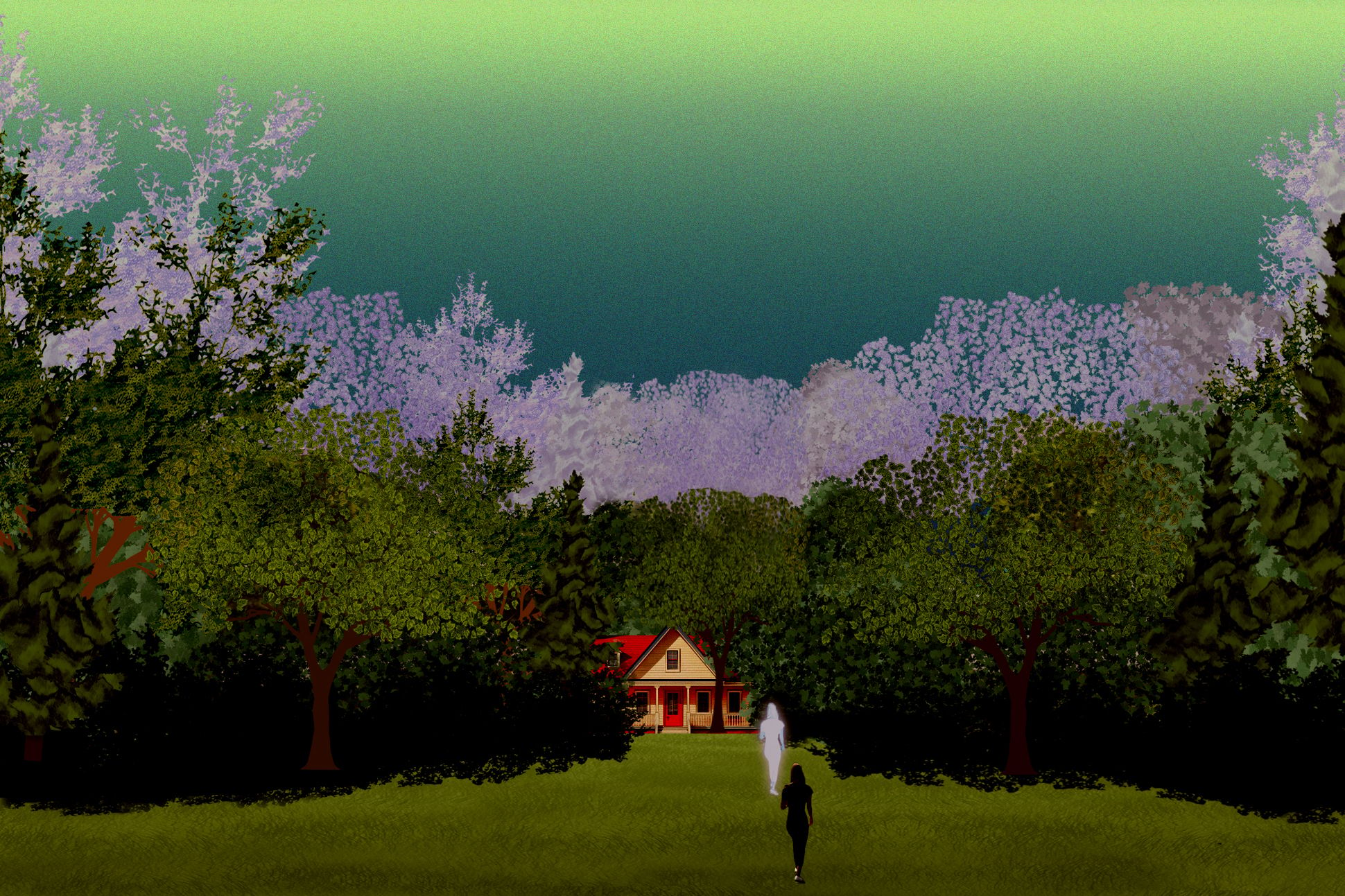
Art by Gigi Rose Gray.
During my first year of college, in February 2018, when I’d convinced myself that biology was my vocation and that poetry exceeded my capabilities, Susan Howe came to read. I remember the auditorium in which she appeared and the impossibly glamorous, aloof English faculty that she enraptured. (A tip, by the by: never compare the fashion sense of scientists and humanists.) Why did I attend? I’m not even American. I had lived in Argentina most of my life and grown up in a family of accountants, for whom literature and the arts were foreign. I didn’t know who Howe was and had certainly never read her. I hadn’t attended a poetry reading before; in fact, I’d never attended any kind of public reading, even if I’d spent much of my childhood sheltered in books. For me, literature was private, something to be read in isolation. But I saw her name and knew, almost instinctively, to go. I don’t remember which poems she read that night, but I recall how frail yet powerful she was, a slight warble—perhaps even a tremble—in her voice despite the assurance she conveyed with every word. I looked at the books open around me in the auditorium and watched as Howe transformed her own texts aloud, revealing intonations I couldn’t yet access and hinting at meanings I have yet to ascertain. I was witnessing a revelation.
After the reading the audience lined up for Howe to sign. I, who didn’t own any of her books, who had never read her or even heard her name before seeing it on an ugly red poster, ran outside to buy a copy of My Emily Dickinson (1985), her groundbreaking examination of the Belle of Amherst. I didn’t buy Howe’s poems, you see; even then I feared them. What happened next has been a source of profound embarrassment to me ever since, the kind of faux pas an aspirant—I didn’t know it then but that’s what I was—can never allow. I didn’t know what to say as I stood before Howe, book in hand, so in a misguided effort to mix sincerity and humility into charm, I asked, “Where should I start with reading your work?” I think she was baffled by the question—at the time, I thought she must have been insulted, although that seems unlikely in hindsight. She pointed to My Emily Dickinson. “That’s probably the best one,” she said, “but that’s an essay. You should go chronologically for the poetry.” The next day, I bought Frame Structures (1996), which collected her earliest poems, and The Europe of Trusts: Selected Poems (1990), which collected her major 1980s work. Within a month I had read and misunderstood both.
Susan Howe led me into poetry. To me, she stands as poetry made flesh, removed from private interiority, ushered with discomfort into the world. She is my America, the language I have recreated from afar and without apology. This essay is my own small devotion, a quiet offering to our great poet of silent generosities.
***
Everyone tells me Howe is difficult, abstruse. An impenetrable intellect, erudite and unfeeling, plumbing the depths of linguistic indeterminacy like a mystic or, worse, a poststructuralist. She weaves references beyond the grasp of mere mortals while giving her pages the frozen sheen of jargon, overly informed by her background in visual art.
I disagree. To read her work is to witness the entire American poetic tradition distilled and reconfigured in the hands of a devotee, moved by a never-quite-explicable love. She writes of that tradition’s origins in the Antinomian Controversy of the 1630s Massachusetts Bay Colony, a theological-political dispute that exiled the followers of puritan minister John Cotton, most notably the brilliant Anne Hutchinson, for their belief that righteousness came from grace and devotion, not law. “Lawlessness seen as negligence is at first feminized and then restricted or banished,” Howe writes, suggesting that Hutchinson’s exile—and her silencing, with almost all traces of her voice erased from the archive—was a foundational effort to discipline the uncontrollable minds of American women. She follows the thread to Mary Rowlandson’s 1682 captivity narrative and its imitators, as well as to the writings of John Cotton, Jonathan Edwards, and Cotton Mather. She chases “North American voices and visions that remain antinomian and separatist,” untamed and rebellious, filled with the convictions of earnest faith. Hermeticism is only a conduit, a pathway into the unspeakable and disallowed. Howe is a poet of devotion, of admiration, almost religious toward the poets and texts that have inspired her to build something new.
She doesn’t confine herself to texts either, having written about scientist-philosophers like the late 19th century father of pragmatism, Charles S. Peirce (in 1999’s Pierce-Arrow), or the 20th century painter-cum-sculptor Paul Thek (in 2017’s Debths). At the core of Howe’s work is the question of reading as a love-form. “Love,” she writes in an essay from her landmark collection The Birth-Mark (1993), “Love is a trajectory across the hollow of history.” In Howe’s work, history echoes in the present carried by love, her borrowed words swirling amid the threatening wilderness against which, she has argued, American literature arose in obsessive, even paranoid relation.
The poetry collections that made her name in the 1970s and ’80s—later gathered in Frame Structures and The Europe of Trusts—examine the brutal exclusions through which the wilderness was tamed or contained, stuffed into boxes and hidden in archives for centuries. How to return to these ruins without leaving herself? She has written often about the antinomian tradition in America, the kind of mystical enthusiasm perhaps only conceivable on this side of the Atlantic, whose explicit and implicit advocates have always been pushed aside and kept from view, as Howe shows. She finds its echoes in Ralph Waldo Emerson and Herman Melville as much as in Emily Dickinson and Nathaniel Hawthorne, in the repression of Dickinson’s poetics into reductive legibility and Noah Webster’s dream of a North American dictionary. In Frame Structures, she explores structures and historical traces: the gardens “between Berkeley Street and Brattle” in Cambridge, the house occupied by both George Washington and Henry Wadsworth Longfellow, which Howe often visited as a child, the horrific “death by fire” of Fanny Appleton Longfellow while sealing an envelope with hot wax from a lighted candle. How containment elides and allows, constrains and preserves. “Hinge Picture” was Howe’s first published poem, riffing on a phrase from Marcel Duchamp’s compilation of notes, The Green Box (1934): “develop in space the PRINCIPLE OF THE HINGE in the displacements 1st in the plane 2nd in space.” How to unify the disjointed in some present array, to make past and present coexist without being “swallowed in the cost of / putting footprints in the sand,” without limiting one to the other?
Like a fortuneteller or an astronomer, Howe chases faint echoes and alignments across text and story, life and myth. She finds the lie, the detail, the twisted fact. Trained as a painter and a graduate of the Boston Museum School of Fine Arts, Howe is uniquely attuned to spatial and visual reality; many of her poems are collages composed of snippets from source texts—trimmed, overlapped, inverted, crossed out. Her books bear the imprint of her folding and arranging and photocopying and scanning. Debths makes that quiet artisanship explicit: one page in the collage section titled “Tom Tit Tot,” composed of snippets from the eponymous fairy tale, a book tracing that tale’s history, the 1937 study The Secret Languages of Ireland, W.B. Yeats (“the poet I loved first”), and more, takes the shape of an inverted fingerprint, off to one side of the page, hidden and visible at once. The form reminds us of Howe’s presence, as if she herself were a kind of collage, or as if she had handed the book to us directly.
Howe’s most recent book is Penitential Cries (New Directions, 2025), a collection divided into four sections, two of which are collage-based texts drawing on various translations of, among other primary texts, the Penitential Psalms—the psalms intoned to request forgiveness for trespass, grouped as such by Saint Augustine. Howe takes particular interest in Thomas Wyatt’s 16th-century translations of the psalms, the “Voyages” of Hart Crane, and mythological figures like King Priam, Cassandra, and Eurydice. In the third section, “The Deserted Shelf,” she reads the famous final stanza of Crane’s “Voyages”—“The Imaged World, it is, that holds / Hushed willows anchored in its glow. / It is the unbetrayable reply / whose accent no farewell can know.” Howe adds: “this stanza is a definition of what every single / line in a poem is bound to promise and yes enjambment is ruthless / as great expectation demands.” Regrets encroach—“We still have plenty of time to start over I could begin with previous publications spirit agglomerations”—and overlap with what can only be described as a literary pessimism unexpected from Howe. The epilogue reads: “Books weren’t always struggling to believe in themselves.” What Howe finds empty, one senses, is not her project but literary futurity itself, perhaps America’s literary futurity in particular: her work exists within a new struggle, at odds with a world coopted or emptied of the richness that her poetry captures so well. She writes in “Penitential Cries”:
Octogenarian widow
pariahs genuflect as we trail across John Milton’s shelves of blue ice.
Glacier inside you might drop off his heart into the “world” he has
given Eve; vain hopes, vain aims—
Jailor, bring the prisoner out, now is too late.
Therefore, she insists: she consecrates her literary reliquaries despite their inconvenience and remains dedicated to her chase—here, of American experimental composer Alvin Lucier’s 2018 composition So You… (Hermes, Orpheus, Eurydice) and Fintan O’Toole’s A Traitor’s Kiss (1997), a biography of Irish playwright and politician Richard Brinsley Sheridan, among other sources. Reading Penitential Cries, one senses that the guardedness of yore, the hesitance at self-disclosure or memoir, has vanished, and in its place the underlying sentiment—the untarnished devotion—arises even purer.
Howe writes about her journeys to Yale University’s Sterling Memorial Library, a frequent subject and shelter for decades, now debased by the cruder facts of our modernity and the United States’ decaying university system, which sustained Howe for so long:
Once safely inside I passed along glassy walls of the new Poorvu Pedagogy Center for Teaching and Learning. The Center offers guidance on how instructors can adapt their teaching to ongoing developments in AI. Here various technology-enabled learning programs are distributed across muffled corridors of new money power. Crisis liquidity, well-mitigated risk, Ivy League endowments, notable portfolio adjustments, stakes in Alphabet incorporated, other bull markets
Orpheus pounds on the soundproof glass. He won’t get through—he’s mythical.
At 88, Howe has grown even more introspective, turning her very method and the fresh difficulties of aging into a poetic subject. The book’s first verse: “Each morning rapid heartbeat. Scattered alphabet”; her later mention of needing a cane, has not diminished her work but intensified it, opening another dimension of archival, textual, and poetic meaning. Even forgetfulness, against which she has struggled for so many years, comes here as a friend, appearing with astonishing lucidity and fear—a fear I recognize in myself: “We have come to be familiar with our recently forgotten name. Sometimes in our memory chamber she looks like murder.”
Penitential Cries, alongside Debths and Concordance (2019), constitutes Howe’s late style—one in which she doubles down on autobiography and emotional intensity while reflecting constantly on closure and opening, endings and beginnings. Not quite as baroquely referential as her early work, these recent poems depict a mind transforming, searching but never quite satisfied, a mind for which poetry and literature and text and meaning are life itself. (“Language a wood for thought” Howe once wrote. All ambiguity: wood is fuel as much as a space to wonder and in which to lose oneself.) Debths borrows its title from a neologism in James Joyce’s Finnegans Wake, her mother’s favorite novel. The word fuses “depths,” “deaths,” and “debts,” alluding to childhood, to the first Trump presidency—which lingers unstated in the background, as the poems tend to “one / fact supported by no fact” and malefactions and perverse powers and “After millennium a little / before at brink at the brink”—and to the experience of memory in old age: “I seem to go back to things that do not belong / to me,” she writes. One senses, in reading this latter-day Howe, that she has begun to treat her younger selves as a subject, at a certain remove:
I am here to slay the
dragon in the ready-made name of an earlier Susan. While
there is still time do you know anything about my watch
being stopped?
The readymade: Duchamp, without being named, returns a half-century on like yet another hinge. Howe herself has made (or found) herself a disobedient or misused object, her method, her myriad altars of devotion, coalesced in page upon page. It is this encounter with what she once wrote—not regret but contemplation and perhaps self-questioning—that defines her late style.
***
In “There Are Not Leaves Enough to Crown to Cover to Crown to Cover,” the essay-preface to The Europe of Trusts, Howe develops a psychogeography of her private and ancestral world. One is reminded of Robert Lowell’s prose memoir “91 Revere Street,” though Howe’s reach and linguistic dexterity exceed even his. She recounts how her father, Mark DeWolfe Howe—a legal scholar, Harvard professor, and biographer of Oliver Wendell Holmes—left Cambridge, Massachusetts, for the European theater of World War II. Elsewhere she writes of Mary Manning, her famous actress mother, whose Irish blood “wasn’t good enough” for the DeWolfe Howe family. Howe’s poetry is autogenealogical: preoccupied with her mother’s Irish terroir and her father’s lineage, its contact with Boston’s prominent Quincy family and the DeWolfes (or d’Wolfs) stature as a founding New England clan. “Men in the early d’Wolf and Howe families were generally sea captains, privateers, slave traders,” Howe writes in “Frame Structures.”
While she has not addressed the DeWolfe family’s intense involvement in the slave trade at length—Charles DeWolfe (then spelled DeWolf) was “one of [Rhode Island’s] biggest slave traders” in the late 18th and early 19th centuries—that fact produces, for me, the most memorable reverberation in the essay. Another forebear, James d’Wolf, a sociopathic slave trader who “had a reputation for having slaves thrown over the side” and took pleasure in “cutting their hands off at the wrist personally” lay low for a few years until a new district attorney dismissed the case. Howe writes: “When this murderous ancestor could finally afford to buy his own slave ship he christened her Sukey. Sukey is my nickname.” Howe comes from uncanny stock and finds in her family tree a rhyme scheme for American history, virtues and sins alike. Resonances are not explained—Howe is never didactic and always honest—but left to vibrate upon the page.
The Europe of Trusts, which includes that essay, is Howe’s most personal book and the least outwardly referential, though it does cite King Lear and Esther Johnson, the subject of Jonathan Swift’s epistolary A Journal to Stella (1766). Howe’s collection works as a key, an almost theoretical articulation of what drives her project:
I write to break out into perfect primeval Consent. I wish
I could tenderly lift from the dark side of history, voices
that are anonymous, slighted—inarticulate.
Even within her own genealogy, Howe finds the recess, the secreted and uncertain and often feminine antinomy. Her father’s subject, Oliver Wendell Holmes, was a childhood friend of the James family (theologian Henry Sr., novelist Henry Jr., philosopher William, and diarist Alice) and a member of what Charles Peirce called “The Metaphysical Club,” the discussion group led by Peirce, James Sr., and Holmes in which Peirce claimed the philosophical current of Pragmatism was born. He’d also been acquainted—if not quite friends—with Ralph Waldo Emerson. But Howe’s attention falls to the minor and the forgotten: to what, in “Chipping Sparrow,” the final poem of Penitential Cries, she calls “Special visitors // Walking on stilts / in snow.”
As she recounts in Pierce-Arrow, Charles Sanders Peirce, despite his stature and his influence on Pragmatism and American thought, died in ruin—unofficially exiled from Harvard and Johns Hopkins—after marrying a mysterious woman named Juliette, who may have been Roma and of European provenance, and who outlived him in isolated squalor at Arisbe, their Pennsylvania estate. In The Birth-Mark, Howe repositions Anne Hutchinson—the wayward puritan who challenged colonial Massachusetts’ religious authorities and was banished into the wilderness, where she later died violently, for her dissent—at the core of “the primordial struggle of North American literary expression.”
Perhaps no single figure materializes these interests and preoccupations more clearly than Emily Dickinson, Howe’s most sustained subject of devotion. My Emily Dickinson places its namesake at the heart of 19th century American literature, on par with Emerson and Walt Whitman, no longer the madwoman in the attic or a figure “starving of passion in her father’s garden,” as William Carlos Williams had it. Howe’s Dickinson is erudite, a voracious reader of George Eliot and Edmund Spenser and Elizabeth Barrett Browning. “Her talent was synthetic,” Howe reminds us, a reconciliation of all that happened around her, all that she read and wrote and heard, as much as a unique mark of her genius. As she would with Melville in “Melville’s Marginalia,” a poem collected in The Nonconformist’s Memorial (1992), Howe studied the annotations Dickinson made in books and found in her underlinings and letters to her family, loaded with literary discussion, yet another key. Howe added: “the way to understand her writing is through her reading.” In these books and notes lay unexplored inroads into Dickinson’s unrelenting and spectacular uniqueness, the play with allusion and “the vital distinction between concealment and revelation” that distinguishes her poetry.
Howe insists on the importance of Dickinson’s visual symbols. “Emily Dickinson suggests that the language of the heart has quite another grammar,” she writes. A century of (almost entirely male) editors and critics—Williams, Harold Bloom, Hugh Kenner, and F.O. Matthiessen, among them—elided Dickinson’s complex syntax, line breaks, and capitalizations, and misunderstood her poetry’s almost prophetic explorations. But Dickinson’s uncommon punctuation and style acquire all-important meaning when subjected to Howe’s painterly sensitivity to the whiteness of the page and language’s regimented incursions into it. In “These Flames and Generosities of the Heart,” an essay from The Birth-Mark, for instance, she reproduces Dickinson’s poems with the line breaks their author intended, as well as with perfect recreations of her punctuation, presumably produced by scanning the original drafts. Howe unmade consensus and shed received wisdoms: “‘Authoritative readings’ confuse [Dickinson’s] nonconformity.” To read, to read and understand or apprehend or glimpse must be to liberate, an incantatory and even mystical practice of attention. Never flatten; never flatter.
It has been said before that Howe’s insights into Dickinson also apply to herself. She, too, is a scholar, a woman swimming in her time and constructing an idiosyncratic and unmistakable hermeticism. A “library-cormorant,” to cite a snippet of Samuel Taylor Coleridge that Howe mentions in her introduction to The Birth-Mark. As she writes in the essay “Submarginalia,” also collected in The Birth-Mark, “Sometimes I know you just from reading. It is the grace of scholarship. I am indebted to everyone." To a degree rivaled by very few poets in recent memory—only Anne Carson, or Muriel Rukeyser of The Book of the Dead, or some pages of Frank Bidart—the protagonists of Howe’s poetry are often others, specific others and their texts and her own reading of them.
Her poems, that is to say, are poems of reading, prompted by specific doubts and fueled by her quiet decades in the archives, mostly those of North America. Hers is a style of reading whose energy and electricity and underlying sentiment stem from devotion: Susan Howe has built an altar and called it poetry. A very personal altar, to her mother and father, to her illustrious family and its legacy; a shrine to an American tradition that she has revealed to be even richer than we knew and that may now be fading. To a wilderness from which I have yet to escape.
Federico Perelmuter is a writer. He lives in Buenos Aires.