


Not Another Rock ’n’ Roll Poet
Meet Richard Hell: former punk scourge, avowed nihilist, and genteel man of letters.
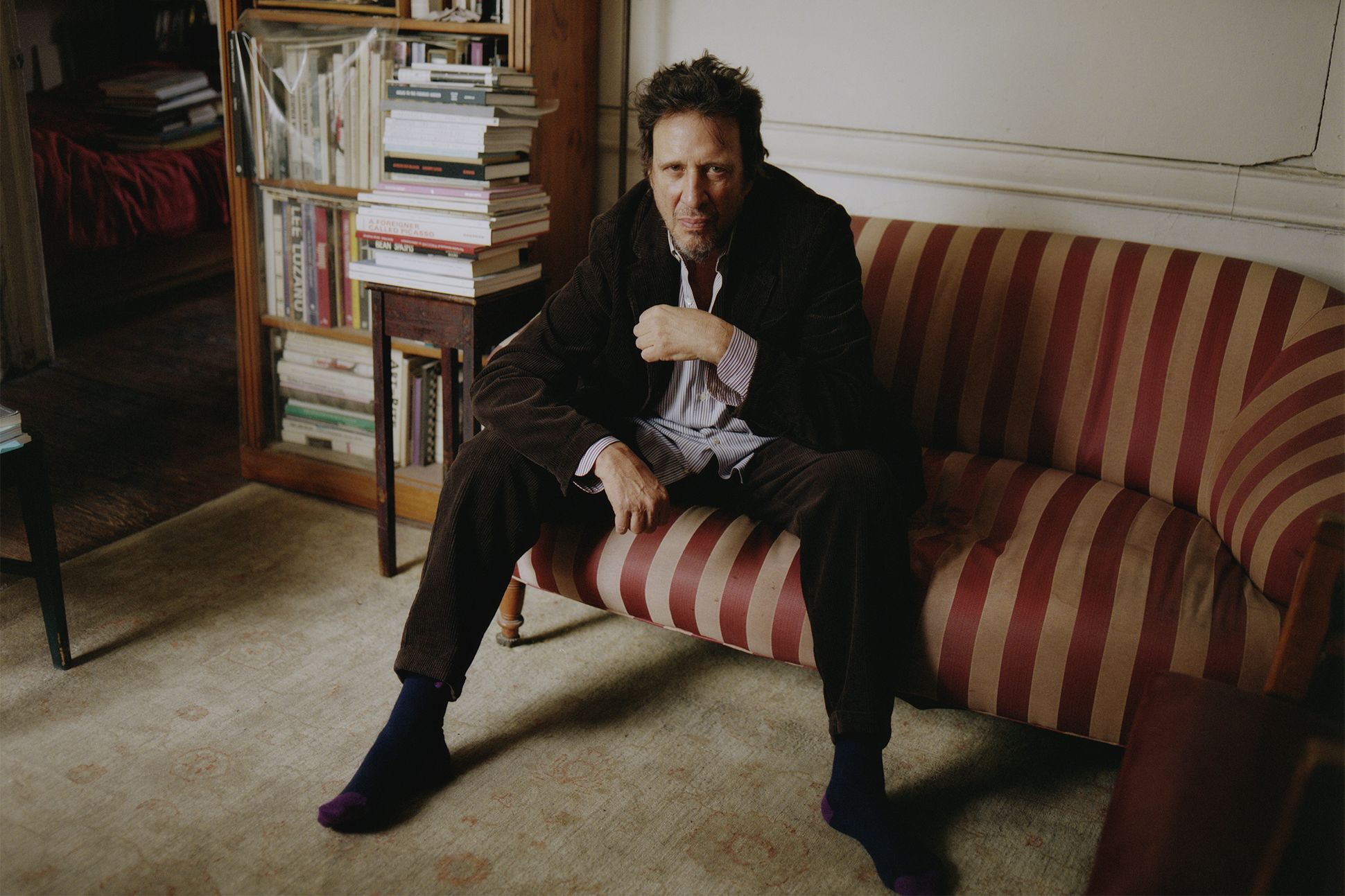
Photo by Meghan Marin.
Toward the end of the 1980s, Richard Meyers found himself looking for work. It was a familiar situation. Over the years, he’d been a stock boy at Macy’s, a door-to-door magazine subscription salesman, a shelver at the main branch of the New York Public Library, a taxi driver, an office temp, a mail sorter, a longshoreman, a construction worker, and a clerk at various bookstores up and down Manhattan. Jobs had been plentiful and rent was cheap, so he never stuck around for long. His decade as a rock star, with occasional writing and acting gigs, was the lengthiest tenure of employment he’d ever had. But in 1984, he gave that up, too.
Meyers and his former schoolmate Tom Miller had started a band in 1973; they changed their names to Richard Hell and Tom Verlaine and, later, their band’s name, from the Neon Boys to Television. Hell left Television in the spring of 1975, as he would soon leave the Heartbreakers, another punk band, for whom he was recruited to sing and play bass, before either group had recorded an LP. By the time the English band Crass declared “punk is dead” in 1978, Hell was largely responsible for defining the genre’s style, affect, and philosophy. Blank Generation (1977), his debut as frontman of the Voidoids, provided the movement with a sort of thesis statement: “I was sayin’ let me out of here / before I was even born,” he sings on the first verse of the title track, a playful refusal of confinement that survives to this day. Following fabled shows at CBGB and Max’s Kansas City and tours opening for the Clash and Elvis Costello in the UK, a second and final album, Destiny Street, was released in 1982. Barely midway into his thirties, Hell had burned out.
“It wasn’t only because I naturally tend to do drugs or that drugs flood the rock and roll scene,” he told me, sitting barefoot in bootcut jeans at his living room table on a sunny Saturday afternoon last December. “I was uncomfortable as a professional rock musician . . . I didn’t like the life of touring.” At 76, his Kentucky drawl faintly audible, it’s easier to recognize him as Richard Meyers the gentleman poet than Richard Hell the junky bassist.
In fact, Hell had come to New York the day after Christmas in 1966 because he wanted to be a writer. Among recording artists of his era who have sought—and in some cases achieved—regard as poets, Hell stands apart. Unlike Leonard Cohen, Lou Reed, Patti Smith, Gil Scott-Heron, and Nobel laureate Bob Dylan, the majority of Hell’s creative output exists outside the music industry and, taken as a whole, casts his pivotal role in punk as a short-lived, if significant, detour in an otherwise bookish existence. Much has been made of his sprezzatura haircut, torn clothing, fuck-all attitude, struggles with addiction, and reputation as a ladies’ man, all of which have engendered imitators and unwanted press. Less has been said about Hell’s life in literature, which comprises dozens of poems, essays, and notebooks collected and uncollected; magazines edited and contributed to; an acclaimed memoir; and two novels, the second of which, Godlike, was reissued by New York Review Books this February.
As pop stars continue to corner the market on meter and rhyme, inducing catharsis in audiences wooed by production value and parasocial desire as much as any appreciation for beauty, truth, imagination, or craft, Hell’s work is a welcome reminder that at its core, poetry is oppositional. To him, the poet is a trickster, an imp of the perverse who exists at the borders of cultural norms and breaks all of the rules. Using language to undermine his own unconscious assumptions, Hell has achieved a method of spying reality through a glass darkly, subverting established principles and returning to poetry the thrill he mined from rock and roll.
***
Hell grew up in Lexington, Kentucky, where he was born in 1949 to two academics: his mother, an aspiring English professor, and his father, an experimental psychologist who died suddenly when Hell was seven. His was a troubled youth of broken hearts, failing grades, and stolen cars. When his mother completed her doctorate and secured a teaching post at Old Dominion University, Hell and his younger sister, Babette, moved with her to Virginia. With financial support from his paternal grandmother, Hell enrolled at Sanford, a co-ed prep school in Delaware, where he met Verlaine. He was expelled from twelfth grade when, fresh off a suspension for smoking morning glory seeds, he convinced Verlaine to run away to Florida. They hitchhiked as far as southeastern Alabama, where they started a brushfire and spent a night in jail. Sanford's administration didn't forgive the two-week absence, and the pair parted ways for public school. Once he'd saved up $100 working in a storefront newsstand that specialized in pornography, Hell dropped out and caught a bus to New York.
Although books were “highly respected” in Hell’s home, it wasn’t until adolescence that he began to take literature seriously. When he was 15, he discovered the work of Dylan Thomas, the “rare famous” poet without a university education.
“Dylan Thomas was a guy who found a way of life where he basically lived by his wits as a literate person,” Hell told me. “He was glamorous, he was reckless, he didn’t do what people told him to do, he was funny, and his poetry was so rich and musical, you really got the feel of the poems more from the music of them than any intellectual interpretation. That inspired me, and was the first time I found a model for what seemed interesting and meaningful as a way of life for myself.”
William Carlos Williams was another early influence, albeit a negative one. If people admire this, Hell thought, poetry is going to be a breeze. From Jack Kerouac, he inherited a lust for the heart of Saturday night, and Hell’s earliest poems pullulate with Joycean profanity and wordplay. Though he wasn’t yet aware of the New York School of poetry, migrating south of 14th Street and east of Broadway at the dawn of 1967 was like stumbling drunk into the promised land. Once Verlaine got to New York a year or two later, they replenished shelves at the same bookstores and, in their free time, haunted stalls on the lookout for Edgar Allan Poe and translations of 19th-century French writers: Charles Baudelaire, Joris-Karl Huysmans, Comte de Lautréamont, Stephane Mallarmé, Gerard de Nerval, Paul Valéry, Paul Verlaine, and Arthur Rimbaud.
“Out of a lack of any better idea,” Hell took a class at the New School with Filipino poet José García Villa, likely because the course description mentioned Dylan Thomas. But Villa’s approach to poetry was conservative and “really pretentious,” Hell said. “All he talked about was craftsmanship. I didn’t know any better, and I got sidelined by paying attention to what he was saying.” With his classmate David Giannini, Hell started a little magazine, Genesis: Grasp, which published six issues between 1968 and 1971, produced by Hell himself on a Vari-Typer machine in his apartment.

Photo by Meghan Marin.
“The first couple of issues were terrible. We were publishing students from the class and writing to people, arbitrarily seeking contributions,” Hell said. “We wrote to Allen Ginsberg. He sent a poem and we rejected it because it didn’t have the level of craftsmanship. We just didn’t have a clue.” Ginsberg mailed an angry postcard in response; a few years later, he moved into an apartment directly below Hell’s, and the two remained neighbors until 1996.
At 19, Hell began dating artist and poet Patty Mucha, then in the process of divorcing the sculptor Claes Oldenburg. Already in her thirties, she took Hell to dinners and parties with eminent figures in the art world, and he slept over at her enormous loft on 14th Street, which adjoined Oldenburg’s studio. The painter Larry Rivers, who lived one floor above, would play the saxophone at four in the morning. “A couple of years later I learned that he’d drilled a peephole into his floor directly above Patty’s bed to supplement our noises,” Hell has written. “Patty told me he sometimes called me ‘Tarzan.’” The heavyweights he dined with—Robert Rauschenberg, Jasper Johns, Willem de Kooning—offered him a tempting glance into bohemian success. Though the New York schools of painting and poetry overlapped, Hell was ignorant. “I didn’t think painters knew anything about writing.”
Hell advanced his self-education at Peace Eye Bookstore, owned and operated by poet Ed Sanders, where he picked up mimeos by the First- and Second Generation-New York School poets, mostly originating from the Poetry Project at St. Mark’s Church. He and Verlaine “disrupted” the Project’s open readings from time to time. “We had a love-hate relationship with the church—it was just our irritation at anything that was already established, even though they were everything that we actually admired,” he said. “We were nobodies to them, so we had to go over and find ways to offend everybody.”
Ted Berrigan and Aram Saroyan—along with Bill Knott and Tom Veitch, kindred spirits of the New York School—made lasting impacts on Hell during this period, and, to a lesser extent, on Verlaine. “We loved those mimeos and the whole anti-academic idea of poetry, or idea of anti-academic poetry, and doing it yourself, getting an Episcopalian minister to let you use this church to give poetry readings,” he said. Imagery of sex and violence presented with a flair for minimalism and humor, acknowledging that experience precedes any thought or organization, was paramount. Hell also identified with the spirit of collaboration, a trademark of the New York School. Before long, he and Verlaine were passing a typewriter back and forth.
“I noticed that the poems that we were writing weren’t like what either of us wrote separately. They were very different,” Hell said. He and Verlaine were both inclined toward surrealism, but Hell’s tendency to “sabotage a line” in the direction of the “obnoxious and antipoetic” sometimes pissed off Verlaine. Regardless, the process freed Hell from his inhibitions and resulted in what struck him as a consistent style, one that retained the irreverence and first-person voice of his own poems but had been transformed through collision with another ego into a distinct subjectivity. “So I got the idea of conceiving a third party as the author of the poems,” he said. “Tom suggested making it a woman.”
Thus, Theresa Stern was born. The daughter of a German-Jewish father and a Puerto Rican mother, Stern allegedly hailed from Hoboken, New Jersey. In 1973, a photo composite of Hell and Verlaine in drag appeared in her first and only chapbook, Wanna Go Out?, the sole volume published by Hell’s new imprint, Dot Books. Wanna Go Out? was, for him, “an achievement that permitted me to feel like I’d become a poet, even though they were collaborations, and that also enabled me to leave poetry and go into rock and roll instead.”
***
For Hell, poetry means a rejection of all constraints, formal or otherwise. One might easily glimpse an erudite admirer of Maldoror and Frank O’Hara in this sensibility, yet when Hell departed poetry for music in his mid-twenties, he did not advertise his literary bona fides.
“I did not want people to call me a rock poet,” he said, or think that what he was doing “wasn’t legitimate rock and roll.” Observing the bands coming out of New York and England in the early ’70s, Hell grasped the potential to scale up his lyricism in a noisier arena, even if he didn’t know how to play an instrument. Performing amplified sound was like having “magic powers.” As comparable as lyrics like “Love Comes in Spurts” may be to the mischievous pithiness and double entendre of his early poems, Hell does not consider his songs “poetry” in the sense that he understands it. “Songwriting is very strict,” he said. “The lyrics all follow the same pattern . . . whereas I don’t do any of that in my poetry. I have been known to write a sonnet, but it’s very unusual.”
Hell had no wish to be perceived as an intellectual on the Bowery, though in fact he was. He has maintained that any allusion to Rimbaud’s A Season in Hell in his alias was unintentional, adopted by chance at a moment when French Symbolism and its unruly progenitors were enjoying a kind of downtown revival: Patti Smith wailed “go Rimbaud” on side two of Horses (1975), and three years later David Wojnarowicz staged the photographs that became Arthur Rimbaud in New York. Still, Hell’s interest in that enfant terrible paled beside his admiration for the other poètes maudits. Tom Verlaine’s surname only reinforced the association, though Hell has said he regrets less that coincidence than failing to realize, at the time, that his bandmate’s initials—T.V.—quietly conferred ownership of Television itself. Hell left Verlaine for the Heartbreakers the same year Bob Dylan sang, “Situations have ended sad / Relationships have all been bad / Mine have been like Verlaine’s and Rimbaud’s,” on side one of Blood on the Tracks.
Hell’s breakup with Verlaine, who died in 2023, is one of the most bemoaned in the annals of rock—approaching Lennon and McCartney, Buckingham and Nicks, and Morrissey and Marr in prying intolerability. In conversation, Hell shies away from talking about the old music days, as he feels he set the record straight in his memoir I Dreamed I Was A Very Clean Tramp (2012). The two friends drifted apart as their musical interests diverged: Verlaine was increasingly preoccupied with “crystal-clear crisp sweet-guitar suites of highly arranged series of time and dynamics sections in his head,” while Hell pursued obliteration through “the physics of the situation,” thrashing about in the spotlight. According to Hell, Verlaine policed his stage presence and cut his songs from their sets. So, he took off.
He has little faith in his memory anymore, and the autobiography would not have been possible without the abundance of notes still in his possession, a luxury of living in the same Lower East Side apartment for over 50 years: “I regret everything I’ve ever thrown away.” He maintains an archive of his writing in a cabinet above a large armoire in his tiny bedroom, and New York University’s Fales Library safeguards a copy of everything he’s published.
Tramp ends abruptly in 1984, after Hell hits rock bottom, relapsing in his then-girlfriend’s Paris apartment when he was supposed to be getting clean: “A writer’s life is fairly uneventful,” he writes, “and, as this book concludes, every moment of a life contains all its other moments. The tale is consistent, even repetitive, enough. It doesn’t need another twenty-five years.” With this, he circumscribes his hellraising youth as the primary material of his work. Though Tramp deserves respect as a lyrical nonfiction account, the essays collected in Massive Pissed Love (2015) and the novels in which Hell rehearsed narrativizing episodes of his life counterbalance the sober introspection of the memoir with the absurdity and abandon of his poetry and songs.
***
Hell took a circuitous route in becoming a novelist. In the ’70s, he bridged gaps between record company checks by publishing articles in music magazines like Hit Parader. On the cusp of turning 40, he traded on the cachet of his sobriquet for glossier assignments. For the centennial of Mark Twain’s Adventures of Huckleberry Finn, Spin sent him and Punk magazine co-founder Legs McNeil to Hannibal, Missouri, where the two rafted down the Mississippi and camped along its banks for a week. The assignment opened onto a steady freelance hustle writing widely about books, film, art, and music for The Village Voice, The New York Times, Bookforum, New York, Esquire, and dozens of other periodicals, exhibition catalogues, zines, and, later, blogs.
Before these journalism gigs piled up, however, Hell closed out the ’80s working as a proofreader for an electronic typesetting company, drawing on his experience as a small press publisher. Using the shop’s industrial photocopy machine, he produced three issues of Cuz, a journal sponsored by the Poetry Project, which had hired Hell to book its Monday night readings.
In Cuz, Hell published many of the same poets he invited to read at the church: Eileen Myles, Dennis Cooper, Rene Ricard, and, in their first appearances at St. Mark’s, Cookie Mueller (with whom Hell co-wrote a handful of poems) and David Wojnarowicz. Cuz was inspired by The World, in which the Poetry Project had published Berrigan—whose C: A Journal of Poetry Hell considers “the greatest literary magazine of all time”—as well as Myles, Anne Waldman, Ron Padgett, and Joe Brainard intermittently since 1966. The Project contributed no more than $500 per 500-copy run, leaving Hell to cover the rest. But the tools available at his nine-to-five enabled experimentation with design that had long been one of his passions. “In the early days of electronic typesetting, people were really going crazy with the opportunities that created,” he recalled; in Cuz, “every writer got their own typeface.”

Photo by Meghan Marin.
Hell couldn’t yet rely on his music royalties to get by. Having starred in several No Wave films—notably Ulli Lommell’s Blank Generation (1980) and Smithereens (1982), directed by Susan Seidelman, who later gave him a small part in Desperately Seeking Susan (1985)—he hired an agent and tried to make it as an actor. Despite booking an audition for Martin Scorsese, he found the whole process humiliating and couldn’t cut it: “Not only am I really self-conscious, but I cannot stand rejection, and that’s all. Being an actor is continuous rejection. It was just excruciating.”
By the late ’80s and early ’90s, his literary career was starting to take off. An imprint of the Dutch label Soyo Records published a poetry collection, I Was a Spiral on the Floor (1988), as well as a box set of poems recorded to CD, Across the Years (1991). In 1990, the cult New York City publisher Hanuman released Artifact, a reproduction of a notebook Hell kept from 1974 to 1980. Convinced that he’d developed the chops to give it a try, he set to work on a novel.
Go Now (1996) concerns the ill-fated road trip of Billy Mud (né Bernhardt), a strung-out punk singer, and Chrissa, a French photographer whom he alternately pines for and rebuffs, as they attempt to deliver a record executive’s 1957 DeSoto from a garage in Los Angeles to New York circa 1980. Hell himself had gone on such a misadventure around the same time with photographer Roberta Bayley, when Stiff Records co-founder Jake Riviera gave them his credit card to retrieve a 1959 Cadillac with the idea that they might get a book out of it, pitched as a New Wave update to Robert Frank’s photobook The Americans (1959).
“I’ve never been any good at writing plots, and I thought that story was a good premise for a book. Not only did it give me a real-life thing to hold onto, like a raft, but a road trip already supplies its own story,” Hell said.
The novel is almost slapstick in parts, but brutal enough in its honesty and resistance to self-mythology that editors read it as the work of a serious writer—maybe even a new William S. Burroughs—touching off a bidding war that Scribner’s ultimately won. Their editor promised Hell she would publish the book “exactly as the manuscript reads,” which was what he wanted to hear at the time; in retrospect, he wishes he hadn’t. Hell now sees too many self-indulgences and run-on sentences. He especially resented critics’ accusations that the book was autofiction, a genre he disdains. Not without some irony, the advice he’d been given against publishing the novel under his birth name, which he’d gone back to using, for the sake of sales exacerbated the problem. In the aftermath, Hell offered to repay his longstanding debt to Riviera, but the gesture was politely declined.
“When I was maybe 19, I had all kinds of unlikely combinations of interests in the possibilities of writing, and I liked following them all at once,” he said. “I conceived the idea of having a life as a writer in numerous separate bodies of work that had entirely different aims from each other.”
Five or 10 years later, he learned of Fernando Pessoa, the Portuguese poet who’d written under approximately 75 heteronyms, and felt relieved that he hadn’t gone through with his vision of multiple personae. In spite of how central self-invention is to the ethos of punk, Hell does not see his fondness for masks in Whitmanesque terms—for him, it’s not a matter of containing multitudes but exploring different personalities, attitudes, and methods. “I just felt like, why can’t I do that as an artist? People are inconsistent within themselves, so why not revel in that instead of trying to suppress it?”
In Godlike, first published in 2005, Hell continued this practice within a fictional world, resetting the story of Verlaine and Rimbaud on the Lower East Side of his own salad days, adding the characters Paul Vaughn and R. T. Wode to his repertoire of mouthpieces for lines lifted, modified, misquoted, and translated from all of his favorite poets. Critics proved more willing to accept Godlike as fiction than they had Go Now, but most failed to pick up on its historical source material, which, in a sense, is autobiographical as well.
***
Ars poetica is a recurrent mode in Hell’s poetry (see especially “In the Morning,” “I Was a Spiral on the Floor,” “Marriage,” “Dead Man Poem,” “Autobiography of a Small, Mean Man,” various untitled poems, his 2023 collection What Just Happened, and Rabbit Duck, a 2005 collaboration with David Shapiro), but the form reaches its apotheosis in Godlike, whose subject is no less than the meaning of poetry itself. Hell had always wanted to write a book about street poets. Vladimir Nabokov’s metafictional novel Pale Fire, which Hell devoured in his teens, served as a paradigm for the poioumenon he would write, and in the legend of Verlaine and Rimbaud, he found the basis for a narrative.
In terms of thwarting convention and living against society, Hell saw similarities between Paris in the 1870s and New York in the 1970s, and by centering the novel around two gay acidheads—Paul and T.—he figured he could once again refashion a readymade scenario while avoiding the charges of navel-gazing that had plagued Go Now. Even so, the protagonists remain composites: James Schuyler, John Wieners, Johnny Rotten, the author himself, and his old friend Tom all leave their trace (another poet named Ted was, of course, modeled after Berrigan).
Godlike is framed within the notebooks of a middle-aged Paul, who in 1997 has converted to Catholicism and is in and out of the hospital, where he is treated for alcoholism-induced nervous breakdowns, much like Paul Verlaine was in his final years. In the early ’70s, he meets T., a shit-stirring teenager who has arrived in the city to inform all of the local poets that he thinks they’re full of it. Before long, T. has seduced Paul into deserting his pregnant wife, squandering what cash he has on liquor and drugs and checking them both into a fleabag hotel where they write poems, take turns at the typewriter, and engage in the most sordid fornication that Hell has written to date (Burroughs, Cooper, and Gary Indiana would be proud). Hell reimagines Rimbaud and Verlaine’s disastrous sojourn in London and Brussels, where Verlaine shot and wounded the younger poet, blending his own past with literary history such that buses carry Paul and T. to Memphis, Florida, and back. By the novel’s end, Paul has tracked his estranged lover to the very hospital where he has been admitted, but it’s too late: T. is already dead.
The closest Hell has come to a postmodern novel, Godlike is an intertextual bricolage of references and language vandalized, counterfeit, or stolen. For example, it’s no secret that Berrigan “totally worshiped Frank O’Hara,” as Hell put it, and so Ted, the character inspired by Berrigan, writes poems in the O’Hara mold. “I call them ‘translations,’ but they’re not,” Hell explained. “I wouldn’t use any words that Frank O’Hara used—it’s tone as much as anything.” The first few lines of one poem replicate O’Hara’s “I did this, I did that” poetics, unmistakable even without consulting the source:
Most of all I meant to come to you;
along the way, my boat
got entangled.
I know it seems it’s always that way.
In breezes, at dawn, with the heavy
metals of the current blasting, I can’t
Seem to get a single moving profile caught
or am I tackling and the wheel’s
awry, birds already long awake.
For you I salvaged the prow
and partly wasted
coffers of plight. Headings
that exposed me to the vagaries of urine
razed my thoughts, and
if I run aground it’s probably decided
by the grateful dead
those who kept me from coming to you.
This strategy struck Hell as a new and specific way of writing poems, but one could counter that it’s the same thing he’s been doing since the era of Theresa Stern: assuming another identity in order to express himself.

Photo by Meghan Marin.
These days, Hell feels like he’s painted himself into a corner. “I’ve come to believe that everything’s determined,” he told me. “I don’t think people can help who they are and what they do. And I also think that there’s no meaning.” If an exit from Hell’s “intellectual trap” is in sight, it may be in the direction of Lautréamont, who, after writing “one of the most violent, hopeless, depraved, sick books ever written,” published Poésies under his given name, Isidore Ducasse, shortly before dying at age 24. “It was a bunch of maxims, the whole intention of which was to encourage people, give them courage, hope, and an idea of a moral compass and virtue,” Hell said. “So I think maybe that’s how shit works. You go to an extreme and there you are at the other extreme.”
As out of sync as this desire to write “something whose whole purpose is just to give pleasure and not to take positions” may be in these divisive times, Hell has never been one to go with the flow. “Of course no writing can rival reality, but reality’s easy. Just exist and there it is,” he writes near the end of Godlike. “Still, a person has to make a living somehow.”
Andrew Marzoni is a writer, teacher, and musician in New York.