


Beyond Black Appalachia
Affrilachian evolution and postcolonial community in the poetry of Frank X Walker.
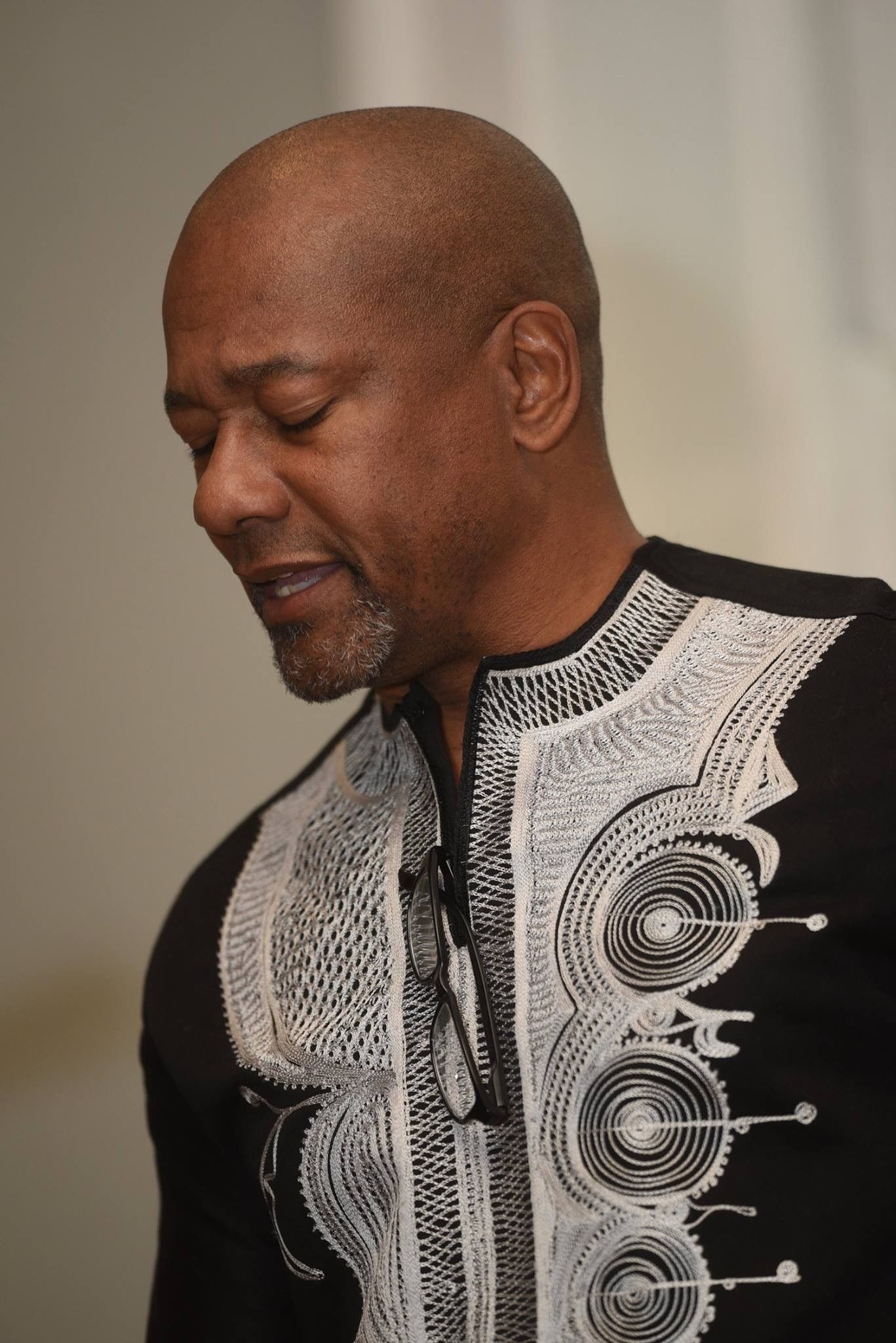
Frank X Walker reading at the Carnegie Center for Literacy & Learning, Lexington, Kentucky, circa 2021. Photograph by Shauna M. Morgan.
One of the first poems I ever loved by Frank X Walker was the one that bears the title of the term he made famous. For days after reading “Affrilachia,” this line beat inside me like a drum:
anywhere in appalachia
is about as far
as you could get
from our house
in the projects
yet
What struck me most about this poem were the stereotypes it seems to demolish, the boundaries it dissolves. In these few lines, Frank X Walker—X as I came to know him—illustrates the expansive distance between Appalachia and Blackness but also their enmeshment; he reminds his readers that the two are more aligned than people might initially think. There is more to this poem, more that comes after his “yet”—parallels between the connections to food, to family, the lineage of porches that link all the residents of Appalachia—and to X, it makes them kinfolk.
and hee haw
are burdensome images
for kentucky sons
venturing beyond the mason-dixon…
In 1991, X coined the term “Affrilachia” after discovering that the dictionary defined Appalachians as white residents of Appalachia. He wanted a term that interrogated the perceived distance between his Black space and definitions of Appalachia that required whiteness as a prerequisite. X was born and raised in Danville, Kentucky; his family was one of the few Black families in town, and so he began reading and eventually writing to cope with his isolation and to articulate his experience. That work became more focused once he began his undergraduate studies at the University of Kentucky under the tutelage of the late Gurney Norman, one of Appalachia’s most revered voices. Norman recognized and cultivated X’s talent and his craft, helping him hone his voice and find paths to publication. As his regional reputation grew, X built community with other nearby Black writers and poets. Together with accomplished poets such as Kelly Norman Ellis, Crystal Wilkinson, and Nikky Finney, X formed the Affrilachian Poets. This collective of Black writers and other writers of the global majority felt locked out of the designation of “Appalachian writers” and pushed back against a regional invisibility, trying to define and claim their own space.
As the originator of the term Affrilachia, X’s own writing is also where Affrilachia first comes to life. X likes to tell people that he started as a fiction writer: his first publication was in the University of Kentucky newspaper, a story he wrote in Norman’s class. Norman’s fiction—its narrative deftness, its connection to nature, its meticulous mapping of the interior lives of people and the relationships between them—also migrated into X’s poetry, which is where X has spent much of his artistic energy since his early days as a fiction writer.
I first met X in the summer of 1994. I was a student at Kentucky’s Governor’s School for the Arts, a summer arts program for teens. X was the first person to look at my work and scowl, which initially seemed like judgment but which I soon learned was careful scrutiny. It was novel to be read this way, to be spoken to as if my work had weight. What’s more, I soon learned he treated the whole of my workshop cohort the same way. This is simply the way X shows up in the classroom and in the world.
For many students like me, Frank X Walker is a touchstone, someone whose critique and considered care makes you want to stay in his orbit, and like many students, I orbited. I came back to GSA as a resident advisor for two summers in college and worked for X while he served as the program’s director. I read his work in his first book, Affrilachia, and sought out his work in lit mags; I conjured up his guidance when I attended the University of Iowa for my MFA in fiction. X, meanwhile, published with increasing frequency and acclaim. He moved from GSA to several university creative writing positions before finding his academic home at the University of Kentucky. He won award after award for his work, from the Lannan Literary Fellowship for Poetry to an NAACP Image Award to honors from Cave Canem and the National Endowment for the Humanities; eventually he became Kentucky’s poet laureate, the first Black writer to earn that designation.
When I decided to pursue my doctorate in 2013, I knew the University of Kentucky was where I wanted to be so I might have the opportunity to work with him again. That fall, once again his student, I dedicated myself to learning more about the legacy that X built. In the two decades since I met him, he had become one of Kentucky’s most celebrated writers and revered teachers, as well as one of the country’s most quietly influential Black poets.
Much of the work in X’s thirteen collections of poetry falls into three categories. The first is a broad array of autobiographical poems about family and community, where X ruminates on the bittersweet beauty of children and romantic love, the tragedies of addiction and loss, the complicated connections between family members and friends. The second are poems—some autobiographical—about the interconnectedness of Black people with land and nature, particularly in rural contexts. The third, which comprises six of the books in X’s body of work, are persona and protest poems that bring history into the present and are undergirded by a Black radical consciousness and an eye toward justice. These poems offer a kaleidoscopic rendering of crucial moments in American history through the lens of lives too often footnoted: Lewis and Clark’s expedition from the perspective of Clark’s slave, York, Sacagawea, and other Indigenous voices they encountered; the rise of thoroughbred racing through the voice of Isaac Murphy, the legendary nineteenth century Black jockey; the assassination of Medgar Evers from the perspective of Evers’s widow, his brother, his assassin, and even the bullet that took his life; the COVID-19 pandemic and the 2020 protests from X’s perspective; and the Civil War through the voices of the Black Union soldiers who enlisted in exchange for emancipation.
pulled the trigger, before I rocketed through
the smoking barrel…
though not enough about the power of dirt.
My mama used…
the trees had commenced to dressing up
the fall harvest an the garden
was already…
The sampling of work included in this folio offers a selection from each of these categories so that readers can understand the scope and evolution of X’s work over the past three decades. His work maintains its roots in the Black Appalachian experience but has branched and blossomed into expansive narratives of love, community, resistance, and reinvention that connect it to the work of other marginalized writers across the globe.
In the past thirty years, X’s work, the term Affrilachia, and the Affrilachian Poets have all become sources of solace and inspiration for a multitude of artists and writers. They all have evolved over time far beyond their original intent and meaning, reminding readers and residents alike of the diverse citizenry of Appalachia, and they have led to a renaissance of Black writers and writing in a region historically dominated by white voices.
The history of Appalachia as a defined region goes back to 1896; since then, its borders have gone through twelve major revisions. As X asserted in a 2016 interview with artist Virginia Rosenberg, “The county I was born in [Boyle County] is one county away from the [Appalachian Regional Commission] definition of Appalachia, but the disenfranchisement and poverty that define [Appalachia] did not stop at the border.” The connection between Appalachia and Affrilachia, noted X, has less to do with exact parallels in geography and more to do with shared values and practices. To Rosenberg he pointed out commonalities between Appalachians and Affrilachians “such as a sense of place, a set of morals valuing family and community, oral traditions, love of music, and puritan work ethic.”
Since 1991, X has found these shared values and practices in other countries where, as in Appalachia, people are resisting colonial domination and the oppressive structures, systems, and stereotypes that facilitate that domination such as poverty, disenfranchisement, educational deprivation, ecocide, and violence. In his welcome letter for the 2019 issue of pluck!—the journal that X established in 2007 at Northern Kentucky University and has published since 2009 at the University of Kentucky—he writes of flying into the country of Eswatini, whose poets are featured in the special issue, and finding not only a familiar landscape, but familiar values: “A love for the family and the land, Affrilachian bedrocks, shined through when my Eswatini students shared their work.” Eswatini, wrote X, mirrored much of what he’s found in his travels, which is a kinship and abiding connection to the neocolonial and postcolonial stories and experiences shared by people around the world:
Being forced to regularly defend a definition of Affrilachia without imposing geographical boundaries on it has been a fight I have welcomed over the almost 30 years of activity of the Affrilachian Poets, but flying over coal mines and into the mountains and landing in the predominantly Black country ... of Eswatini, formerly known as Swaziland; and reflecting on earlier travel to the mountainous regions of Ghana, Cuba, and Jamaica; and reconnecting with a former University of Kentucky student, who is now in Australia organizing poets and using my pedagogy to teach creative writing to Aboriginal poets of color, has forced me to think of Affrilachia as even more expansive than I had ever imagined.
It is fitting then, for Affrilachia, its people, and its literature to ignore the Appalachian Regional Commission’s (ARC’s) boundaries. Affrilachia is not a geographical space or determined by identity alone. Affrilachian art and literature are also not affirmed by or determined by colonial projects, although they still exist in relation to them. Affrilachia is not a replica of the experience of all Black Appalachians but a Homi K. Bhabha-esque third space, a hybrid creative movement where elements of Black and Appalachian culture meet and blur; where artists with shared values but from varied walks of life create their art, navigate their identities, and plot their liberation; where they resist the strictures of the ARC’s project by building artistic community far beyond the ARC’s reach.
I write this to honor my mentor, to hold up a mirror to what already exists. And now, I hold the mirror of X’s work up to you, readers, to ask you how it might change you, what you might see. I have never and will never inhabit Affrilachia, and yet I cannot escape its influence. Affrilachia and the work of the Affrilachian Poets move through me, and my work is forever changed. But the story of Affrilachia is best told through the work of Frank X Walker and the other poets and writers whose art has meticulously built this movement.

Young Frank at Tolliver Elementary School, c. 1970. Photographer unknown.

Frank X Walker reading at the Carnegie Center for Literacy & Learning, Lexington, Kentucky, circa 2021. Photograph by Shauna M. Morgan.

2019 Kwanzaa Celebration in Lexington, Kentucky, l-r Shauna M. Morgan, Haki R. Madhubuti, and Frank holding Kumasi. Photograph by Shauna M. Morgan.

Frank and Kumasi observing the fauna on the banks of the Wallowa River, 2022. Photograph by Shauna M. Morgan.

Frank painting in his home studio as Kumasi plays nearby, 2019. Photograph by Shauna M. Morgan.

Frank presenting a broadside of “Why I Don’t Stand” to fellow Kentuckian, African American Historian Yvonne Giles, 2025. Photograph by Shauna M. Morgan.
This essay opens the folio “Frank X Walker: Kinfolk.” Read the rest of the folio in the January/February 2026 issue of Poetry.
Megan Pillow is the co-author, along with Roxane Gay, of Do the Work: A Guide to Understanding Power and Creating Change (Leaping Hare Press, 2024) and lives in Kentucky with her children.